 Recompeted
What Do You Do When the Set-Aside Doesn't Come Back?
NIWC Pacific's small business cyber vehicle stopped taking orders in March 2022 and its replacement has still not been announced. Sentar held one of those four seats, spent the gap winning unrestricted work, and on Aug. 12 took a seat on the open successor alongside Booz Allen, Leidos and SAIC.
On March 8, 2017, Naval Information Warfare Center Pacific seated four small businesses on a cyberspace science, research and engineering vehicle. Fourteen firms had bid for those seats.
Avanti Technologies, Millennium, Vector Planning and Services, and a Huntsville company called Sentar got them.
The ordering period on that vehicle ended March 7, 2022. Its small business replacement went to solicitation in April of this year and has still not been announced.
"Where does a small business go when the set-aside vehicle it holds expires and nothing replaces it?"
On Aug. 12, Sentar answered that at NIWC Pacific by taking a seat on the unrestricted version, which covers the full scope of the same requirement, next to Booz Allen Hamilton, Leidos, SAIC, Deloitte, GDIT, Accenture Federal and Parsons.
What the 2017 seat actually produced
A seat on a multiple award vehicle is permission to compete for orders. Sentar competed.
Five task orders came off contract N66001-17-D-0116, awarded between May 2017 and May 2021 and running out to 2023, worth $13,634,310 obligated: research and development for the NAVAIR enterprise and VH-92 in May 2017, a services order that November, another in July 2019, the Cyber Analytics in-service engineering agent logistics work in March 2021, and JINE and MIBS services two months after that.
When the seat stopped taking new orders, the company stayed at the command through other people's vehicles. Three more orders landed under N66001-21-D-0078 and one under N66001-21-D-0198, the VH-92 CAMEO program at $2,923,469, which runs to May 2, 2027.
Thirteen NIWC Pacific prime orders in all, $18,650,710. That is not a large number by the standards of this readership, and it is the entire point: it is nine years of continuous presence inside one command's cyber portfolio, built one order at a time.
Fifty offers, twenty-nine seats
Here is what Sentar walked into on Aug. 12 (chart below).
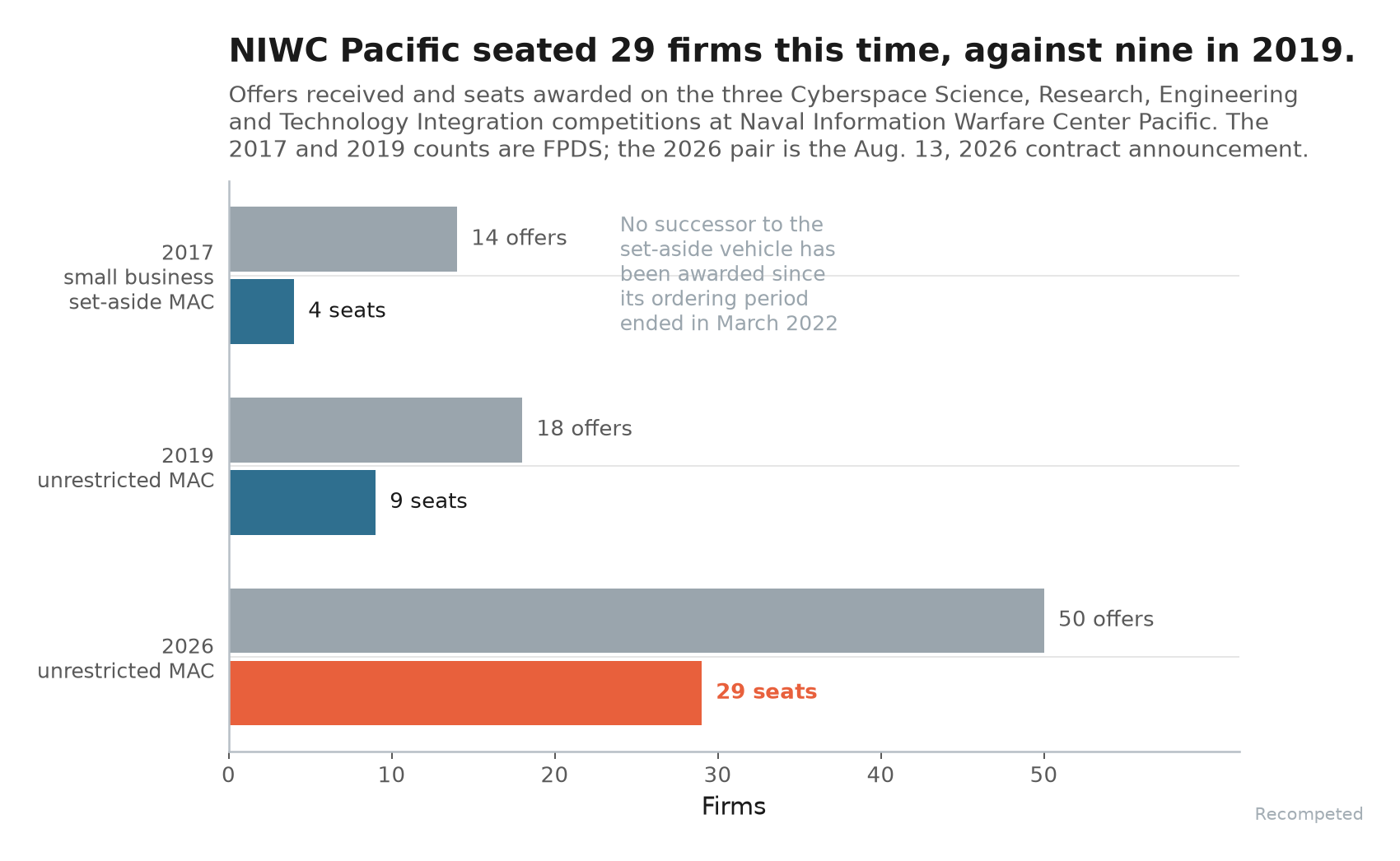
NIWC Pacific's unrestricted cyberspace vehicle drew 18 offers in 2019 and seated nine firms.
The 2026 successor drew 50 offers and seated 29, on a $278,000,000 ceiling that reaches $400,000,000 if the two-year option is exercised.
Period of performance runs Aug. 12, 2026 to Aug. 12, 2031, cost-plus-fixed-fee, ordered competitively among the holders.
The competition itself was quick by the standards of anything carrying a Top Secret facility requirement.
Solicitation on the street Feb. 17, proposals due March 19 at 11:00 Pacific, award announced Aug. 13.
No industry day.
Five of the nine 2019 holders are on the new list. Of the four firms from the 2017 small business vehicle, Sentar is the one on it.
The gap was not spent waiting
The four and a half years between the set-aside vehicle going quiet and the unrestricted award are the part worth reading closely.
Sentar was already winning open competitions at scale during them.
In September 2019 it took $131,398,225 of Defense Health Agency cybersecurity work on a SeaPort order, full and open, seven offers. In May 2024 it took another DHA risk management and operations order at $63,791,678, full and open, five offers.
So the company that showed up to the 2026 unrestricted competition arrived with seven years of nine-figure open-market delivery behind it, accumulated while its set-aside seat at NIWC Pacific sat idle.
Sentar dates to 1990, when Peter and Karen Kiss bought Wake Research Group and renamed it. The company describes itself as woman-owned, and it is still headquartered in Huntsville, with offices in Charleston, Columbia and San Antonio.
We are making no claim about its current size status, and that is deliberate. The seat it just won did not require one.
Final Thoughts
The honest caveat: the award has not reached FPDS, so the offer count, the seat count and the ceiling all come from the Aug. 13 announcement rather than from a contract record, and the numbers beside each awardee's name on that board are not confirmed PIIDs.
There is a version of this story that reads as a company outgrowing its protection. The record tells a plainer one: a set-aside lane went dark for four and a half years at one command, and by the time it did, the firm holding a seat on it had built enough unrestricted past performance that the darkness decided nothing.
So if you hold a seat on a set-aside vehicle whose ordering period ends inside the next two years, put one question in this quarter's pipeline review. What would you bid if the follow-on never posted?
Thanks for reading.