 Recompeted
Two Companies Hold Half the Hardware Coming Off Contract
1,207 DoD contracts worth $421.6B come off period of performance between February 2027 and August 2028. Ranked by who actually holds them, the hardware half is an oligopoly and the services half is a market with 299 names in it.
We refreshed the desk's expiration pipeline this morning. 1,207 DoD prime contracts above $50M come off period of performance between February 17, 2027 and August 10, 2028, carrying $421.60B in obligations.
Then we asked the dull question underneath it. Who holds them?
The answer depends entirely on which half of the board you count, and the two halves are not close.
Two Boards, One Number
Split the board the way FPDS splits it, on the first character of the product-service code: a digit is a product, a letter is a service or R&D. That gives 531 hardware rows carrying $289.69B against 676 services rows carrying $131.91B.
The desk ran that same cut on August 8 and got the same shape, so far nothing new.
The new work is the rollup. We pulled the corporate parent for all 1,207 rows straight off the USAspending award record, one request per row, so Sikorsky lands under Lockheed Martin and Electric Boat under General Dynamics instead of standing as their own names.
Rolled up, 396 corporate parents hold the entire board, and three of them (Lockheed Martin, Boeing, RTX) hold 55.0% of the dollars.
Now split it and walk the cumulative share down each ranking (chart below).
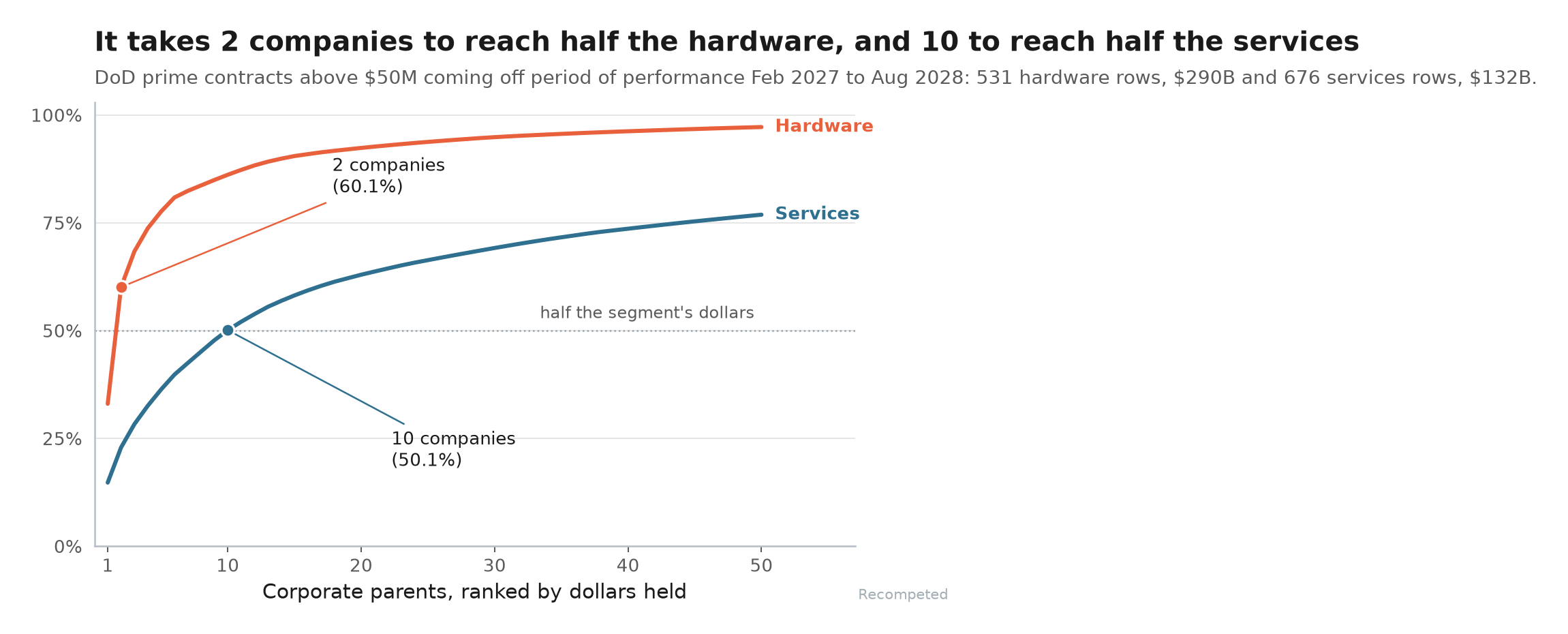
On the hardware side, two names clear half. Lockheed at $95.6B across 94 rows and Boeing at $78.4B across 55 rows put you at 60.1% before a third company enters.
Ten names reach 86.1%. Fifty reach 97.2%, and there are only 128 parents on that side to begin with.
On the services side it takes ten names to cross half, and the tenth is a dredging joint venture. Fifty names get you to 76.9%, against 299 parents in the segment.
Same board, same morning, two different markets.
Where the Tail Actually Is
Call the services half what it is. It's the whole non-product side of the board, so it carries the R&D and construction families along with the professional-services work most of you actually chase. And the top of that curve is not services in the sense a capture shop means it:
- Two Bechtel hazardous-substance rows on 2009-vintage Army contract numbers, $5.00B and $4.54B
- One Navy military construction project, P-209 Dry Dock 3 replacement, $3.07B to a three-way dredging JV
Three of the segment's ten largest holders, and not one of them recompetes into anything you would staff a capture team against.
Strip that off the top and the number underneath is the one worth having.
216 of the 299 services parents hold exactly one contract on this board. Between them, $38.63B. The median services parent holds $107.7M, which is one mid-size program and nothing else.
Ranks twenty through thirty-two are the band most readers recognize: SAIC at $1,065M, Novetta at $949M, BL Harbert at $842M, Arctic Slope at $758M, Peraton Risk Decision at $736M, Leidos at $733M, Odyssey Systems at $721M, LinQuest at $701M. Nobody in that band holds even 1% of the segment.
Final Thoughts
The $421.6B is the number that ends up on a slide, and it is the least useful number on this page.
Two-thirds of it is hardware, and better than two-thirds of that sits with three companies holding franchise positions that do not turn over because a period-of-performance date arrives. F-35 sustainment is not up for grabs in 2028 because a field in FPDS rolls over.
The board that behaves like a market is the smaller one: $131.9B, 676 contracts, 299 holders, and 216 of those holders standing on a single contract apiece.
That last group is the one worth staring at. A company with one contract on this board has one bad recompete between itself and zero, which makes it the shortest list of names on the board with something to lose.
Everyone on it is either your teammate next year or the incumbent you unseat.
Thanks for reading.