The Vehicle Closed Before the Order Did
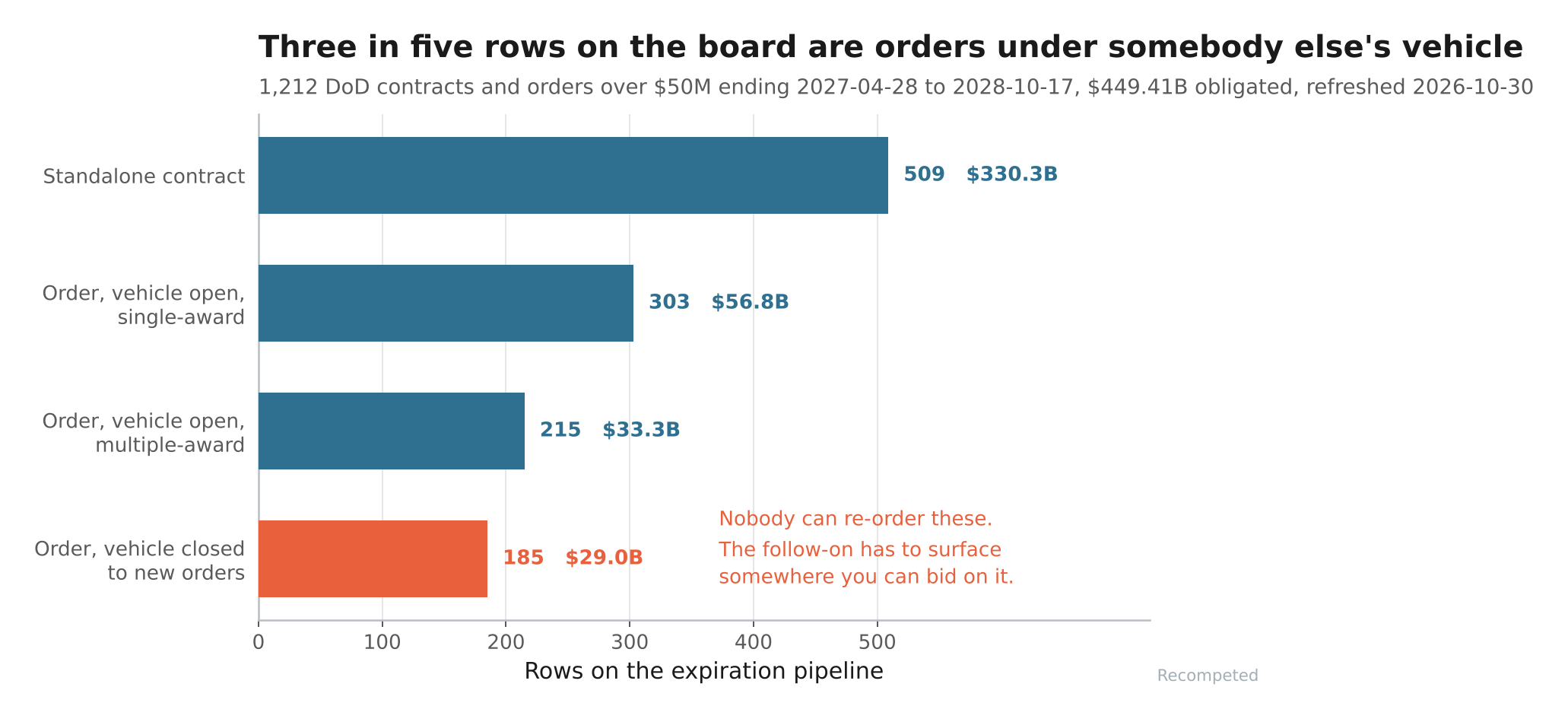
We classified every one of the 1,212 contracts on the expiration pipeline by the paper underneath it. 703 are orders rather than contracts, and 185 of those ride a vehicle that can no longer take a new order. That changes who is allowed to bid on the follow-on, and when it has to surface.
Yesterday a $20,000,000,000 GWAC quietly ran out of ordering authority, and the work riding it did not notice.
CIO-SP3's ordering period had already been pushed out eight times after its original 2022-07-14 date. The last of those extensions landed on 2026-10-29, and the newest action on the record, P00025 signed 2026-09-04, left it there.
One of the DoD orders underneath it is ValidaTek-CITI's $170,678,622 DISA ED-E work, HC102820F0943. Mod P00072, signed 2026-06-17 on the exact day the order would have ended, moved it out a full year to 2027-06-17.
So the order outlives its vehicle by eight months, and its pipeline row looks like any other expiring incumbency.
It isn't one. Neither are a lot of the others.
What the board is actually sitting on
We refreshed the expiration pipeline this run: 1,212 DoD contracts and orders over $50M with end dates between 2027-04-28 and 2028-10-17, $449.41B obligated.
Then we pulled every row's parent and read the parent's whole FPDS history: 10,449 action records across 478 vehicles, which gives each row a carrier and each carrier a last date to order (chart below).
703 of 1,212, a clean 58%, are orders sitting under a parent vehicle. The other 509 are standalone contracts holding $330.30B, because that is where the platform work lives.
The 703 split three ways, and the split is the whole point:
- 303 rows ride an open single-award vehicle. The agency can place the follow-on back to the incumbent with no competition at all.
- 215 rows ride an open multiple-award vehicle. Only seat-holders get a fair-opportunity shot.
- 185 rows, $28.96B, ride a vehicle whose ordering period has already closed.
That last bucket is the one worth your afternoon.
Why a dead vehicle is the good news
Two lines of the FAR do all the work, both current as of FAC 2026-01.
FAR 16.505(a)(2): "Orders shall be within the scope, issued within the period of performance, and be within the maximum value of the contract." A new order after the period ends is simply not available.
FAR 52.216-22(d): an order issued during the effective period "and not completed within that period shall be completed by the Contractor within the time specified in the order." The order survives its parent on purpose.
So the mechanism runs in two steps:
- While the vehicle is open, the incumbent's position renews through paper nobody outside sees, because an option exercised on an existing order is not a new order.
- When the vehicle is shut and the existing order runs out of its own options, the requirement has nowhere to hide. It has to come out as a new solicitation, a seat on some other vehicle, or a sole-source justification with a docket number.
The median row in that 185 is already 420 days past the day its carrier closed. These are not edge cases.

The rest of this brief is for subscribers.
The specific solicitations, dockets, and dates to act on sit past this line.
$50 a month, or $500 a year.
Already a subscriber? Sign in