 Recompeted
The Phase III Shop That Showed Up With a Bid
Shipcom Federal Solutions has been paid $74 million by the federal government since 2020, and almost none of it came through a competitive range. On Friday the Houston company won a $16.9 million Army depot network job against six other bidders, which is a different kind of record entirely.
Every dollar the federal government has paid Shipcom Federal Solutions since 2020, across 97 contract actions and $74,072,670, came through one of two doors. One is the SBIR program. The other is an other-transaction agreement.
Through the ordinary door, the one with a solicitation and a competitive range, the Houston company had collected $1,000.
On Friday it won $16,892,413 against six other bidders.
One Line in the Army Section
The Sept. 18 contract board carried it without ceremony: a firm-fixed-price award to Shipcom Federal Solutions LLC for "a secure, resilient and recoverable hybrid infrastructure architecture across an active footprint, integrating existing network assets with private 5G, complementary wireless transport and standards-based information technology and operational technology infrastructure."
Work in Corpus Christi, complete by Nov. 1, 2027, the entire value obligated with fiscal 2026 operation and maintenance, Army funds at award. Contracting activity ACC Redstone Arsenal, PIID W912NW-26-P-A037.
Bids solicited via the internet, seven received.
That office code is worth reading. USAspending carries W912NW as W6QK CCAD CONTR OFF, the contracting office sitting inside Corpus Christi Army Depot, and every other 2026 action on the code is a depot buy (bulk liquid argon, Almen strips, a dust hazard analysis).
CCAD is where the Army overhauls Apaches, Black Hawks and Chinooks, and the Army describes it as playing "a critical role in the Army Organic Industrial Base."
So the buyer is a depot, the requirement is the network the depot runs on, and the winner has 44 employees.
Where the $74 Million Came From
We pulled every FPDS transaction filed against Shipcom Federal Solutions' UEI this morning. Ninety-seven actions, 29 distinct contract numbers, and a distribution that is unusually clean (chart below).
$63,677,098 sits on actions FPDS codes as SBIR Phase I, II or III. Another $3,992,155 sits on two Air Force awards that call themselves SBIR in their own contract text while carrying no research code, including one whose description says the quiet part out loud: "THIS IS SMALL BUSINESS INNOVATIVE RESEARCH (SBIR) PHASE III REQUIREMENT ARISING UNDER SBIR TOPIC AF221-DCSO1." Count those and the SBIR channel is 91.4% of everything.
The remaining $6,402,416 came through other-transaction agreements, mostly a Marine Corps production order and an Army prototype project.
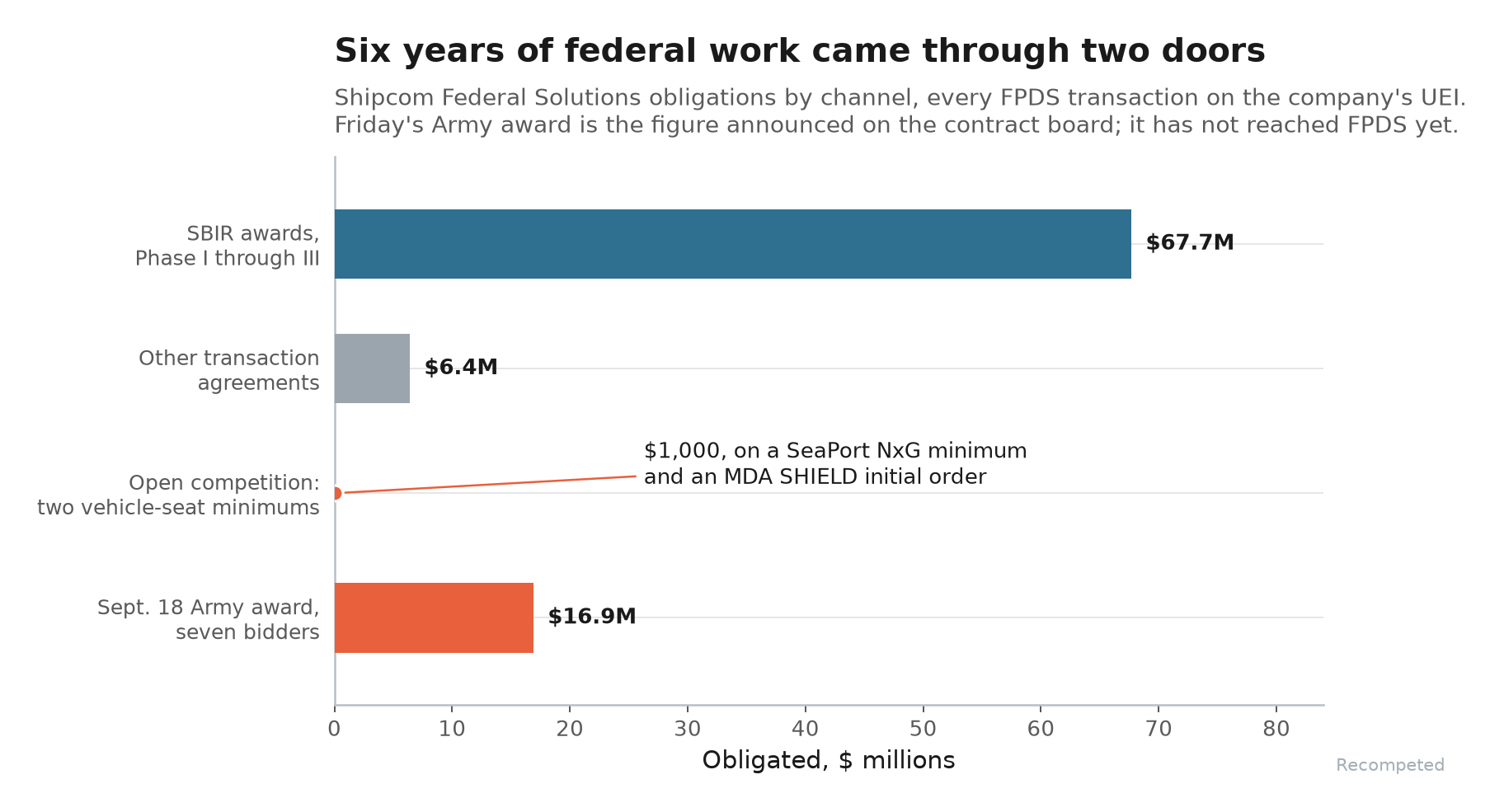
What is left over is the interesting part. The company holds a SeaPort NxG IDIQ, an MDA SHIELD IDIQ, and a FEMA EFAST BPA, and those are the only awards in the record that sit outside both channels and carry a full-and-open competition code.
Between them they have paid $500, $500 and nothing. Seats on vehicles, minimum guarantee drawn, no order behind it.
The single biggest line is N6833524F0065 at NAWCAD, an order under a basic ordering agreement, $42,996,685 base and all options, signed June 2024, FPDS research code SR3. One offer solicited, one received, which is what Phase III looks like when it works.
The Door Most Capture Plans Ignore
15 U.S.C. 638(r)(4) tells agencies and prime contractors, to the greatest extent practicable, to treat an SBIR or STTR award as satisfying the competition requirements of 10 U.S.C. 3201 through 3205, and to issue Phase III awards relating to that technology, sole source included, to the company that developed it, without further justification.
That is the whole mechanism. Win a topic once, deliver, and the follow-on work can be bought from you directly for as long as the sponsoring program keeps funding it. No J&A, no synopsis, no competitive range, and nothing for a competitor to protest on the merits of who else could have done it.
It also leaves a particular shape in the record. A Phase III company accumulates delivery history and CPARS ratings, and never has to price a proposal against five other people who want the work.
Which is why the bid list matters here. The technology was already theirs: the Air Force bought "DESIGN AF DCGS NEXT GEN ENTERPRISE IT SYSTEMS USING 5G TECHNOLOGY" from Shipcom as a Phase I in March 2024, then a $1,797,291 Phase II five months later, both out of AFLCMC C3IAK.
Friday's award is that same competence sold to a different customer through a different door, priced against a field.
Final Thoughts
The Phase III lane gets talked about as a shortcut, and for the program offices using it that is fair enough. What it does to a company's shape is less discussed.
Six years of work that never had to clear a competitive range leaves you with a technical bench, a CPARS file, and no evidence you can clear one.
Shipcom now has the evidence. For anyone building a bidders list at a depot, a small Houston software shop that most account plans have never carried just became a name with a competed award behind it, and there are more like it sitting one topic number away from the same jump.
Thanks for reading.