 Recompeted
The Median Contract Runs Four Years. The Money Runs Nine.
We sorted the $471 billion expiration board by how long each contract has been running. Sixty-four contracts have been in place a decade or more, they hold 38 percent of the money, and 36 of them drew a single offer.
We refreshed the expiration board this morning. 1,218 DoD prime contracts over $50M whose period of performance ends between April 19, 2027 and October 10, 2028, carrying $471,488,744,225 in obligations.
Then we sorted it on a column the board has never carried: how long each of those contracts has already been running.
"How much of the money we call expiring has been sitting in the same place for a decade?"
More than a third of it.
Four Years for the Rows, Nine for the Dollars
Two rows report an end date that falls before their start date, so they get their own paragraph further down and no bucket here. That leaves 1,216 contracts and $468.1B to score on the span from period-of-performance start to the end date now on the record.
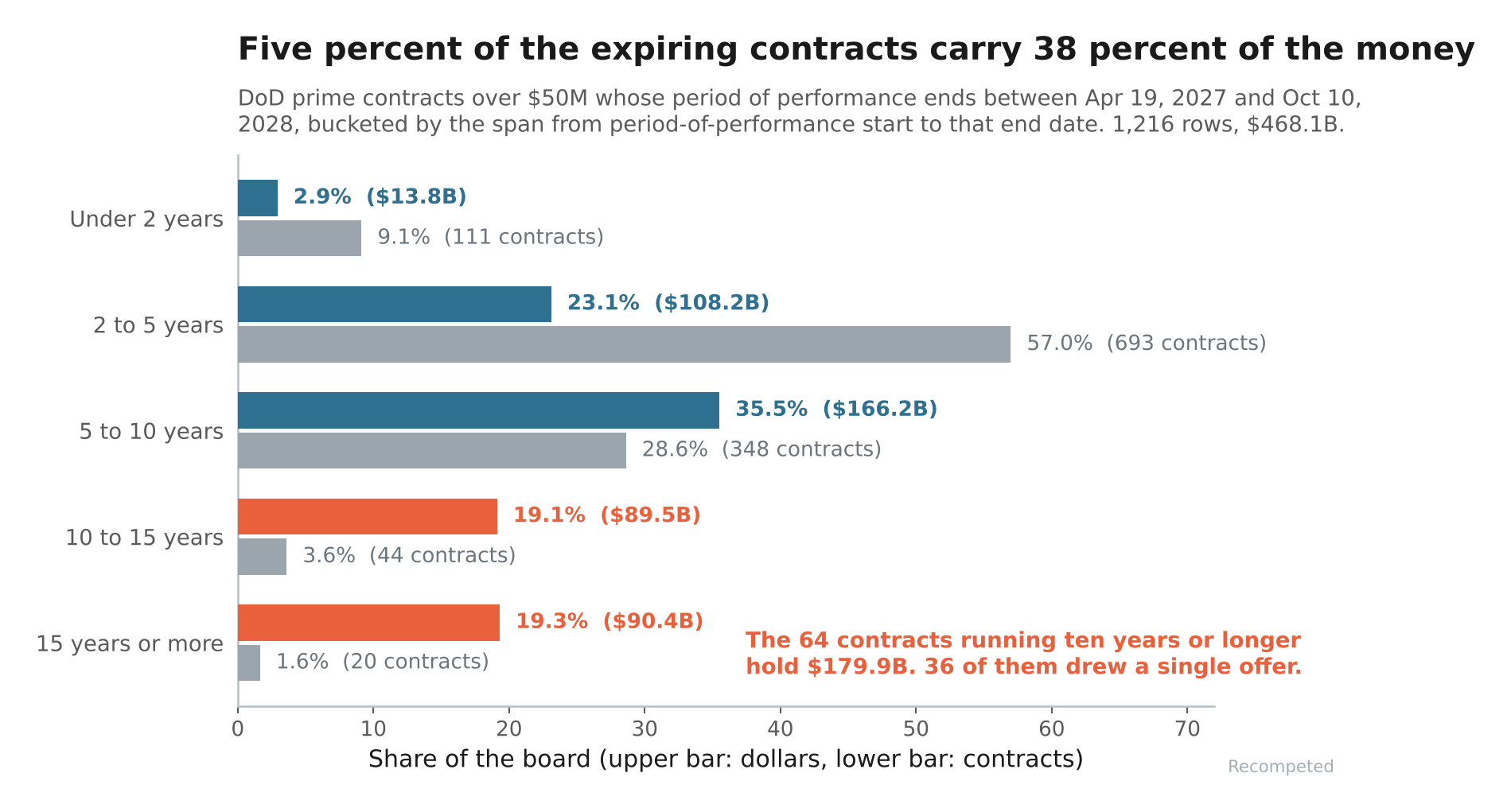
The median row runs 4.17 years. Weight the same spans by obligations and the number jumps to 9.44 years (chart below).
That gap is the whole post.
Over half the board, 693 contracts or 57.0%, sits in the two-to-five-year band on $108.2B. That is a normal services clock: compete it, run a base and four options, recompete it.
The money does not live there. $179.9B, 38.4% of everything expiring in the window, sits on 64 contracts that have been running ten years or longer.
Five percent of your rows. Thirty-eight percent of your dollars.
What Is Actually in the Ten-Year Bucket
Not your pipeline, mostly.
Only 19 of the 64 carry a services PSC, and those 19 hold $14.6B of the $179.9B. The other $165B is platform, sustainment, nuclear propulsion and chemical demilitarization paper, where the contract and the program are the same object.
The biggest line is Boeing's FA8625-11-C-6600, the KC-X modernization program, $31.97B obligated, running since February 24, 2011 and now ending July 31, 2027.
That one was competed, full and open, and it drew two offers. In 2011.
Then N00024-12-C-2115, Electric Boat, $20.39B on a line the record still describes as SSN 792 long lead time material, signed April 2012, coded NOT COMPETED, one offer. Then N00024-96-F-4060, running since November 4, 1996, $9.44B, recipient of record the Department of Energy, which is the longest span on the board at 30.9 years.
Across all 64, 36 drew exactly one offer, together worth $99.98B. And 63 of the 64 have no unexercised option runway left on the record: the potential end date and the current end date are the same day.
So the dates are real. The competition behind them is mostly not.
The Dates Move Anyway
Here is the catch.
N00024-12-C-2115 is in our pipeline with a hand note from September 10, when the row dropped off the board because its award record end date had been rewritten to October 20, 2026. Today the same record reads August 1, 2027 again, which is where it started.
And the two rows we set aside: Lockheed Martin's FA8625-24-F-3034 and FA8625-22-F-3027, Air Force, aircraft PSC, $3.43B between them, each reporting a period of performance that ends 153 days before it begins. Both are coded with an end date you could screen on and a start date that makes it impossible.
Final Thoughts
The reason to care is what it does to a sorted list.
Screen the board on value and end date, which is what every pipeline tool does, and the top of your list fills with the ten-year rows: the biggest numbers, the nearest dates, and almost nothing you can bid. The work you can actually pursue sits in the $108.2B band underneath, on contracts a fraction of the size.
Duration is the cheapest filter nobody applies.
A contract in year eleven with no options left and one offer in its history arrives as a sole-source justification, a restructure, or a new program number, and it arrives on the program office's clock rather than yours. A contract in year four with four bidders behind it is a pursuit.
Same board. Sort it twice.
Thanks for reading.