 Recompeted
The Joint Venture Stops at the Systems Commands
USACE Sacramento handed six of the ten seats on a new $238 million architect-engineer MATOC to joint ventures last night. We pulled every DoD engineering services award notice since October 2025, and at NAVSEA, NAVAIR, NAVSUP, AFMC and SSP the joint-venture count is zero.
Ten award notices came out of USACE Sacramento last night inside twenty minutes, 21:13 to 21:32 UTC, all of them seats on the same $238 million civil works architect-engineer MATOC: solicitation W9123826RA010, awarded Oct. 30.
Read down the awardee column and six of the ten are partnerships.
LH&J/Arcadis, Cornforth-Gannett Fleming, Kleinfelder-Stantec, GFT Arcadis SPK CW, GEI-Tetra Tech Federal, Black & Veatch-Geosyntec. The other four are single firms: AECOM, HDR, RJH Consultants, MGE Engineering.
So we pulled the whole year to see whether Sacramento was unusual.
"Where does engineering work actually require a partner to win?"
It turns out that depends almost entirely on who is buying.
Six Commands, 132 Awards, Zero
We took every Department of Defense award notice posted to SAM under NAICS 541330 with a publish date from Oct. 1, 2025 through this morning. That is 337 notices, every one of them carrying an awardee name.
61 of the 337, or 18.1%, went to a vendor whose registered name says joint venture.
Split that by buying command and the average stops meaning anything (chart below).
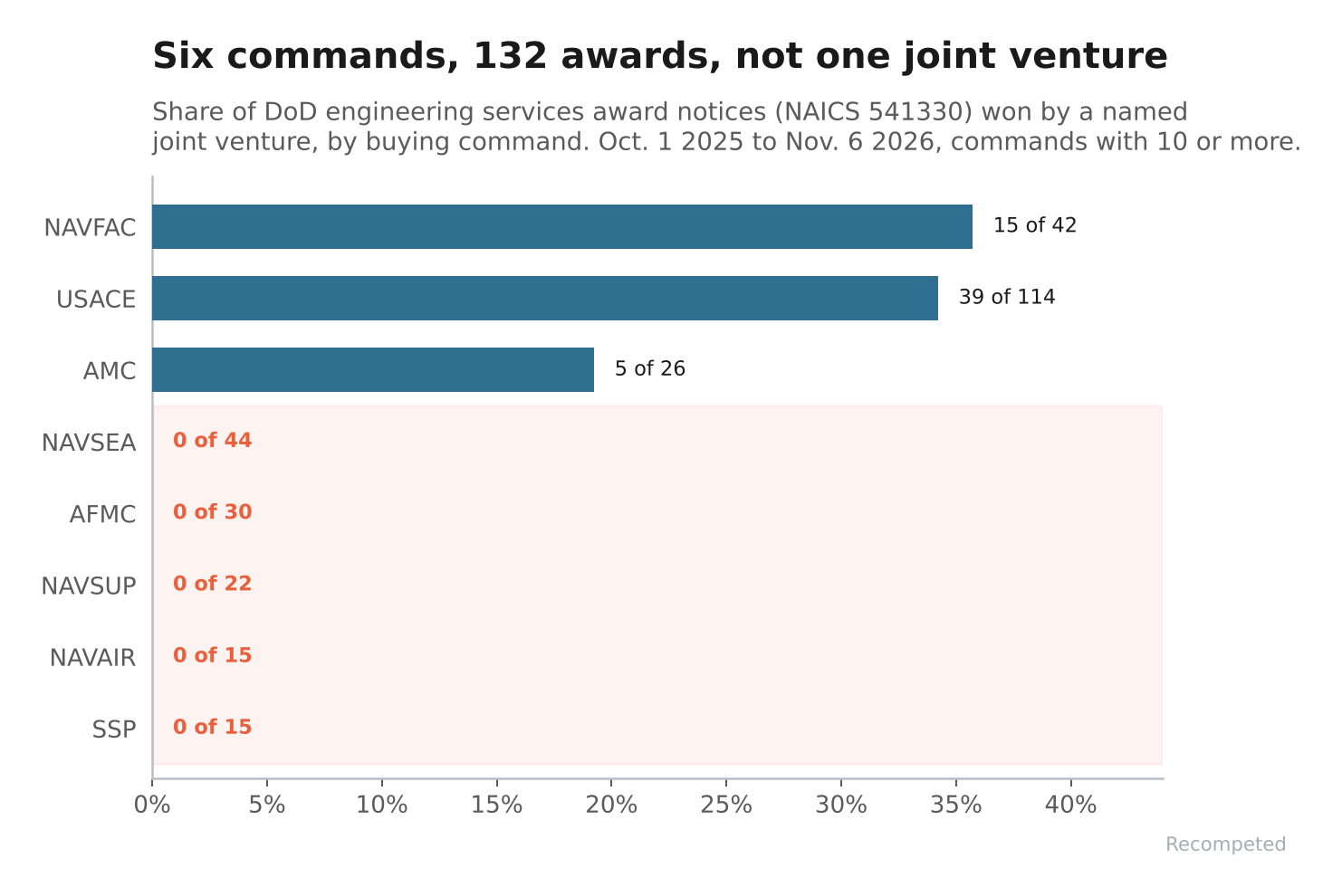
NAVFAC runs 35.7% joint ventures, 15 of 42. USACE runs 34.2%, 39 of 114.
Army Materiel Command sits at 19.2%.
Then the floor drops out:
- NAVSEA: 0 of 44
- AFMC: 0 of 30
- NAVSUP: 0 of 22
- NAVAIR: 0 of 15
- SSP: 0 of 15
- SPAWAR: 0 of 6
That is 132 engineering services awards across six commands without a single joint venture in the winner column. Same code, same fiscal window, same department.
It Isn't the Set-Asides
The obvious explanation is the mentor-protege JV, which would make this a small-business-program artifact rather than anything about the work.
We checked. It doesn't hold.
Across USACE and NAVFAC together, 54 of 156 awards went to joint ventures. On set-aside notices that rate is 39.0%, and on full-and-open notices it is 33.0%.
Pull USACE out on its own and 27 of its 86 full-and-open awards went to a JV.
The joint venture at the construction agents is a general-purpose competitive instrument, used about as readily when SBA status has nothing to do with it.
And at the six commands above, the zero holds on both sides of the line: 0 of 33 set-aside awards and 0 of 99 full-and-open ones.
What the Code Doesn't Tell You
Here is the part worth carrying into a teaming decision.
SBA already knows these are different markets. The size standards table at 13 CFR 121.201 lists 541330 at $25.5 million, then carves out three exceptions and prices them separately: Military and Aerospace Equipment and Military Weapons at $47.0 million, engineering under the National Energy Policy Act, and Marine Engineering and Naval Architecture at $47.0 million.
The regulation splits the code along almost exactly the line the award data splits on.
What the two halves actually reward is different, and that is the practical read:
- At the construction agents, the buy is a design bench. Discipline coverage, licensure in the right states, and past performance on the specific civil works mission are what get scored, and no single firm covers all of it. Pairing is how you fill the sheet.
- At the systems commands, the buy is sustained engineering support on one platform or one weapon system. What gets scored is a cleared workforce, program-specific history and facilities, which live inside one company, and the JV mostly adds a layer of OCI exposure for nothing.
So the vehicle that wins you a seat at Sacramento is the same one that buys you nothing at Dahlgren.
Final Thoughts
The desk has been here before. When USACE Kansas City recompeted its civil works A-E MATOC in August, joint ventures showed up on both the incumbent bench and the winning one, and the shape of last night's Sacramento award is the same shape a quarter later.
None of this says a JV is the right answer at the construction agents. Plenty of single firms hold those seats, and AECOM and HDR took two of the ten in Sacramento without a partner.
What it says is narrower and more useful. If you are sizing a teaming decision off the NAICS code on the notice, you are reading the wrong field.
The command in the organization line is doing the work.
Thanks for reading.