 Recompeted
The Company That Built the Network It Now Has to Defend
NAVSUP Fleet Logistics Center Norfolk asked exactly one company to quote on securing the Naval Observatory's precise time enterprise, and on Monday it announced a $61,570,161 IDIQ to JFL Consulting of Edgewater, Maryland. The five years of work that made that a short conversation are all sitting in the award record.
The security monitoring system has to fit inside a box no bigger than 24 by 14 by 9 inches, survive an EMP, and raise an alert within 60 seconds of detection. The systems it watches have to stay available better than 99.999% of the time and hold compute stability of half a nanosecond.
That is section 3 of the performance work statement attached to solicitation N0018926RL015, Precise Time and Astrometry Enterprise Systems Security, out of NAVSUP Fleet Logistics Center Norfolk. The Navy posted it at 3:06pm on Tuesday, July 14, and closed it at noon the following Monday.
Four business days.
One company was asked to quote, and on Monday the daily contract board carried the result: $61,570,161 to JFL Consulting, LLC of Edgewater, Maryland, a firm-fixed-price IDIQ with a five-year ordering period and a six-month FAR 52.217-8 tail that would take it to $66,705,706. Five thousand dollars was obligated at award, which is the minimum guarantee and nothing else.
"What does a company have to already own before a contracting officer writes 'only one responsible source' and means it?"
What USNO Is Actually Buying
Here is why this matters outside the grounds on Massachusetts Avenue.
USNO is the sole provider of Precise Time and Astrometry data products to the DoD under CJCSI 4650.01H and DoDI 4650.06: precise time and the tools that disseminate it, the Celestial Reference Frame, Earth Orientation Parameters.
In the government's own words, those products are "critical to navigation for any DoD system, and, most importantly, the United States Global Positioning System."
The contract buys the security layer around the transport that carries it, and the requirement's shape tells you how specialized the bench has to be:
- Eight labor categories, all of them named in the PWS: PTA IP Transport Engineer, PTA RF Transport Engineer, RMF Analyst, Program Manager, SCADA Infrastructure Engineer, Physical Security Engineer, Technical Writer, Security Operator.
- A Secret clearance as the floor for every person on the contract, with TS//SCI on some positions.
- Sustainment that includes monitoring, controlling and securely operating remote telescopes and instrumentation, accredited under Navy RMF per DoDI 8510.01.
- Six places of performance, weighted Washington D.C. 80%, Flagstaff 10%, Denver 7%, and then Albuquerque, Honolulu and a site in Chile at 1% each.
So the bidder needs cleared RF and IP transport engineers who also understand SCADA, can carry a time signal to a nanosecond, and can do it at an observing site in the southern hemisphere. The addressable market for that sentence is small.
The Ladder
JFL did not arrive at this award. It walked up to it, one instrument at a time, at the same contracting office (chart below).
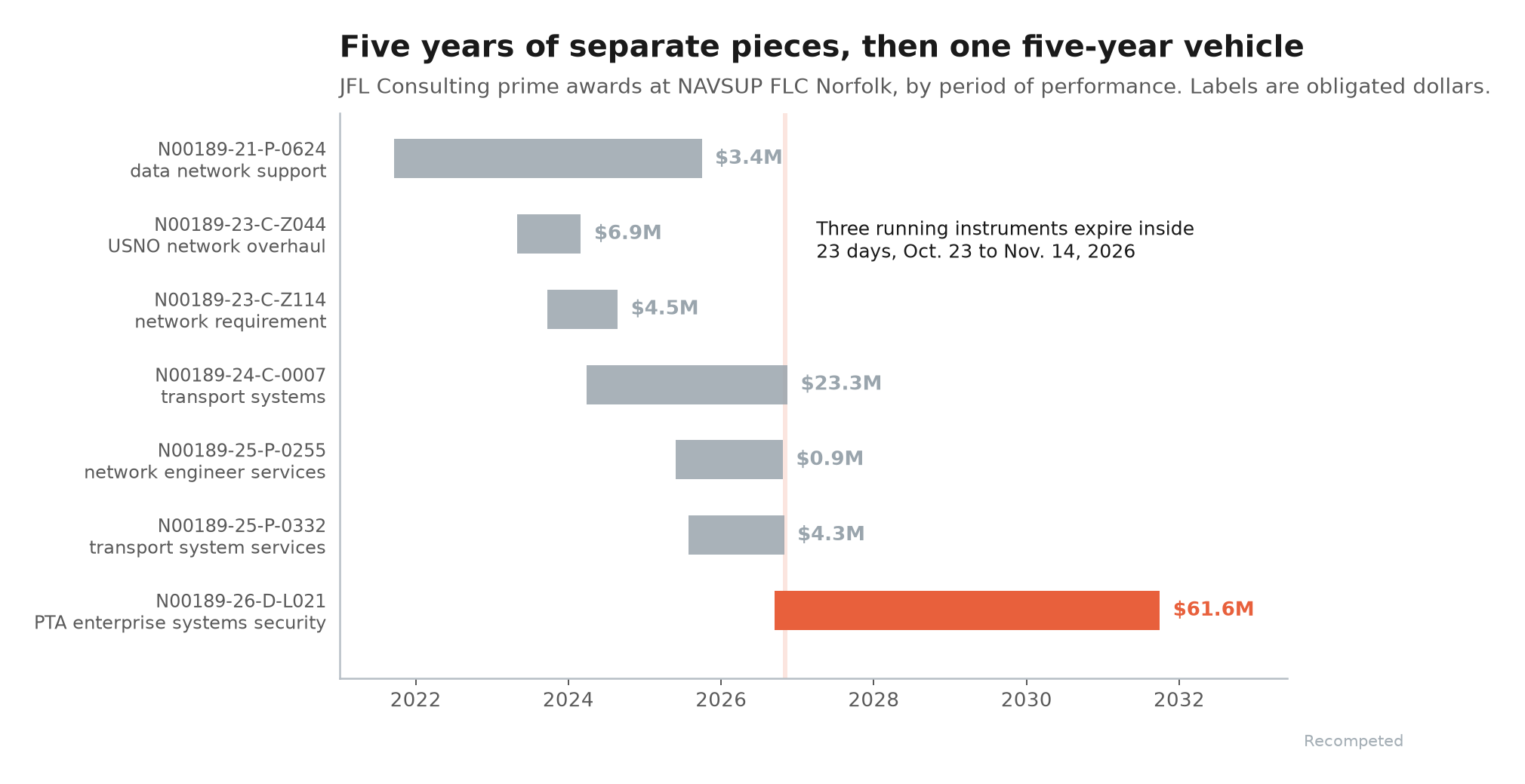
The first was N00189-21-P-0624, data network support, $3,408,157 obligated, signed September 2021. Then the one that matters most for reading the rest: N00189-23-C-Z044, titled in FPDS "USNO NETWORK OVERHAUL - EQUIPMENT," $6,903,406.
Then a network requirement at $4,456,850, then network engineer services, then transport system services.
The big one landed in March 2024. N00189-24-C-0007, $23,293,805 obligated against a $36,959,623 potential, to design, deliver, install and maintain the IP and RF transport system that disseminates precise time and time interval data at USNO.
Four subsystems: unclassified and classified in Washington, unclassified and classified at Schriever.
Six instruments, $43,319,067 obligated across five years, every one of them non-competitive on the record. Five carry the 8(a) sole-source code.
The 2024 transport award carries the other-than-full-and-open code for a single responsible source instead.
Now look at the end dates. Three of those instruments were still running when the new award landed, and they expire on Oct. 23, Oct. 29 and Nov. 14 of this year.
Twenty-two days end to end, all of it inside two months of an award that runs to September 2031.
How the Conversation Got Short
The four-business-day window in July draws the eye, and it is the least interesting thing in the file. The decision was published five months earlier.
On Feb. 19, NAVSUP FLCN posted a presolicitation stating its intent to make a sole source direct award to JFL Consulting, LLC for PTA enterprise systems security, in capital letters: "THIS NOTICE IS NOT A REQUEST FOR COMPETIVE QUOTATIONS." Typo theirs.
That notice ran a two-week window for anyone who wanted to argue the point, and it named the authority the September announcement cited, 10 U.S.C. 3204(a)(1).
Two details worth stealing for your own capture reviews:
- The evaluation factor was price. Section M lists exactly one, evaluated for reasonableness under FAR 15.404-1(b), with options added in per FAR 52.217-5. When the technical question is already settled by who holds the accreditation, the solicitation stops pretending otherwise.
- The same office ran the same play in 2024. Presolicitation N0018924R0015, posted March 16, five days of response time, intent to sole-source the transport systems to JFL, award Mar. 29. The 2026 sequence is a rerun with a bigger number.
The February notice also promised the RFP "on or about 26 March 2026." It arrived July 14 under a different solicitation number, which is the normal case for intent notices rather than the exception.
Final Thoughts
There is a version of this story that reads as an incumbency lock, and it misses what the record actually shows. A firm whose oldest federal award is a $730,450 strategic messaging contract at DTRA in 2017 spent five years turning small, unglamorous network orders at one observatory into a position where the agency's own justification writes itself.
The moat here is the accreditation, the clearances, the four subsystems already installed, and the plain fact that nobody else has run this particular network.
That is a repeatable shape, and the reader running a niche services line already knows it. Take the small order at the mission edge, then deliver the thing that has to be sustained afterward.
The justification gets written years later by someone else, using your own delivery history as the evidence.
Thanks for reading.