 Recompeted
The Archaeologists Who Keep Winning the Recompete
A women-owned firm in Stone Mountain, Georgia has held the Army Corps' nationwide cultural resources vehicle through three straight competitions while the bidder field went from four to thirteen. On Friday's board it took a fourth, at a second district.
Friday's board carried a $9,999,999 firm-fixed-price IDIQ out of the Corps' Mobile District for "cultural resources services." Six bids came in.
Estimated completion Aug. 13, 2031.
That is an archaeology contract, and it is the kind of line a capture team scrolls straight past.
The winner is New South Associates, a women-owned small business founded in 1988 and headquartered in Stone Mountain, Georgia, with offices in Columbia, Athens, Nashville, Greensboro and Fairfax. National Historic Preservation Act compliance is the whole business: archaeology, architectural history, cemetery studies, geophysics, museum services.
It also holds one of the more durable incumbency records in the Army's services book, which is what makes it worth a look.
"How do you hold the same requirement for eight years while the field triples?"
The Vehicle Nobody Screens For
Pull every prime award to the firm's UEI in USAspending's contract record and you get 422 of them, worth $112,395,979 all in.
The median is $84,973.
The largest single award in the whole record is $11,778,107, and 237 of the 422 sit under $100,000 (chart below).
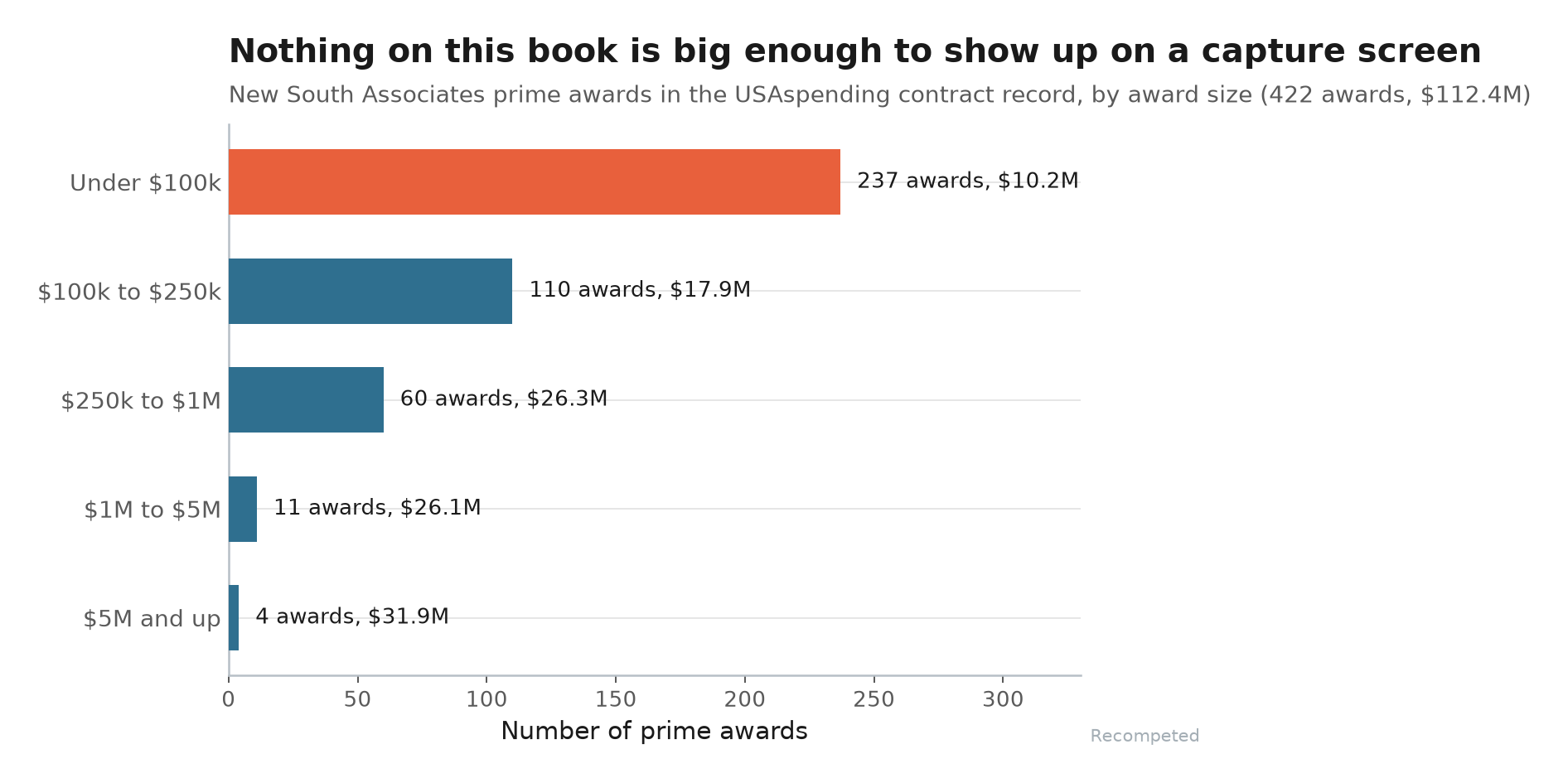
That shape is exactly why nobody sees it. This desk's own expiration pipeline starts at $50M, and New South has never once held anything that would clear the floor.
The work lives in NAICS 541720 and PSC B503, a code family your saved searches almost certainly do not cover.
It still gates other people's schedules. Section 106 compliance sits in front of MILCON and civil works dirt, and the survey happens before the shovel moves.
Four, Five, Thirteen
Where it gets interesting is the competition history.
The Corps' St. Louis District runs the nationwide cultural resources and curation vehicle out of office W07V. It has come up three times since 2017, every time full and open after exclusion of sources, every time as a women-owned small business set-aside:
- W912P917R0015, awarded August 2017 as W912P917D0012. $45,010,000 ceiling, 4 offers.
- W912P920R0010, awarded October 2020 as W912P921D0002. $41,500,000, 5 offers.
- W912P925RA007, awarded December 2025 as W912P926DA015. $40,000,000, 13 offers.
New South took all three (chart above). The ceiling drifted down about 11% across the series while the bidder field more than tripled.
Mobile ran a smaller version of the same requirement. Solicitation W9127820R0020 drew 8 offers and became W9127821D0017, a $10,000,000 IDIQ that stopped taking orders on Nov. 14, 2025.
Nine months later the district put a $9,999,999 cultural resources IDIQ on Friday's board, and the same firm has it through 2031.
Two districts, four competitions, four holds.
What the Money Actually Buys
The single largest award in the record repays reading in full.
W912P921F0209, $11,778,107, three offers, September 2021: "VETERAN CURATION PROGRAM BASE YEAR."
The Veterans Curation Program was stood up in 2009 by the St. Louis District's Mandatory Center of Expertise for the Curation and Management of Archaeological Collections. Veterans get paid employment and training rehabilitating at-risk Corps archaeological collections.
Four full-service labs run in Alexandria, Augusta, St. Louis and San Mateo, with satellites at Texas State University and the University of Arkansas Museum.
The Corps publishes the outcome: 700 veterans trained and employed since inception, and 91% of them into a job or a degree program afterward.
New South manages it. The FY26 flagship task order, W912P925FA073, is worth $5,441,592.96 and ends Sept. 30, 2026.
Final Thoughts
None of this is a pipeline anyone reading can walk into next quarter. These are five-year IDIQs with a set-aside on them, in a NAICS most of the industry has no past performance in, and the newest one already drew thirteen bidders for a ceiling that had shrunk by eleven percent.
The useful part is what the series says about incumbency. Thirteen firms read the same solicitation in 2025, and one of them had spent nine years with the Corps' own collections sitting in its labs.
Past performance built on the requirement itself is the hardest thing in this business to bid against, and it does not care whether the contract is worth $40 million or $40 billion.
The FY26 flagship order ends Sept. 30. The vehicle underneath it runs to March 2030, so the Corps has runway and no particular reason to hurry.
Thanks for reading.