 Recompeted
Seven New Names on a $997 Million Vehicle
NAVFAC EXWC opened market research on its global fuel-systems MACC twenty-two months before the old one stopped taking orders, absorbed a GAO protest in the middle, and still made award with ten days left on the clock. Seven of the ten seats went to firms that had never held one.
The Naval Facilities Engineering and Expeditionary Warfare Center put ten firms on a $997,000,000 construction vehicle on August 21. The eight-seat vehicle it replaces stops taking orders on August 31.
Ten days.
Most of what this desk writes about a contract in its final month is the other outcome: the urgency justification, the bridge, the sole-source extension that buys an incumbent another year while the recompete catches up. So the Global Petroleum, Oils and Lubricants MACC at Port Hueneme is worth stopping on. The work is fuel infrastructure for the Navy and Marine Corps worldwide, cleaning and inspecting and repairing storage tanks, fixing pipelines, keeping cathodic protection and spill containment alive at the places ships and aircraft actually take on fuel. It is the kind of scope that never stops needing a contract behind it.
The Clock Started In October 2024
The sources-sought notice for solicitation N3943025R2001 went up on October 10, 2024, with responses due November 12. That is 689 days before the predecessor vehicle's ordering period closes.
The presolicitation followed on February 14, 2025, and did the thing a presolicitation is supposed to do and often doesn't: it told you the answer to your own capture questions before you spent money. The NAICS and its $45,000,000 size standard. The $997,000,000 ceiling. The plan to award no more than ten contracts with roughly half reserved for small business. The bonding floors. And this line, which is rarer than it should be:
"Information about the current contract and the incumbent contractors (e.g., value of contracts, firm names, addresses, etc.) is included in the solicitation package."
The government handed every offeror the incumbent list. If you were building a teaming strategy against eight seat holders you did not have to reconstruct them out of FPDS.
Proposals closed May 30, 2025. Then the record goes quiet for a year, and the reason sits in the solicitation notice itself, which was amended in late June 2025 with a header advising of a GAO protest.
Award landed 448 days after proposals closed.
Well, that is a long evaluation. It is also the entire point: the office planned a schedule that could absorb a protest and a fourteen-month source selection and still land inside the incumbent vehicle's runway.
It did.
Seven New Names
Match the two seat lists on UEI, which is the only identity test that survives a subsidiary rename, and three of the ten new seats belong to firms that held one on the 2020 vehicle: Aptim Federal Services, Bristol Engineering Services, and Weston Solutions (chart below).
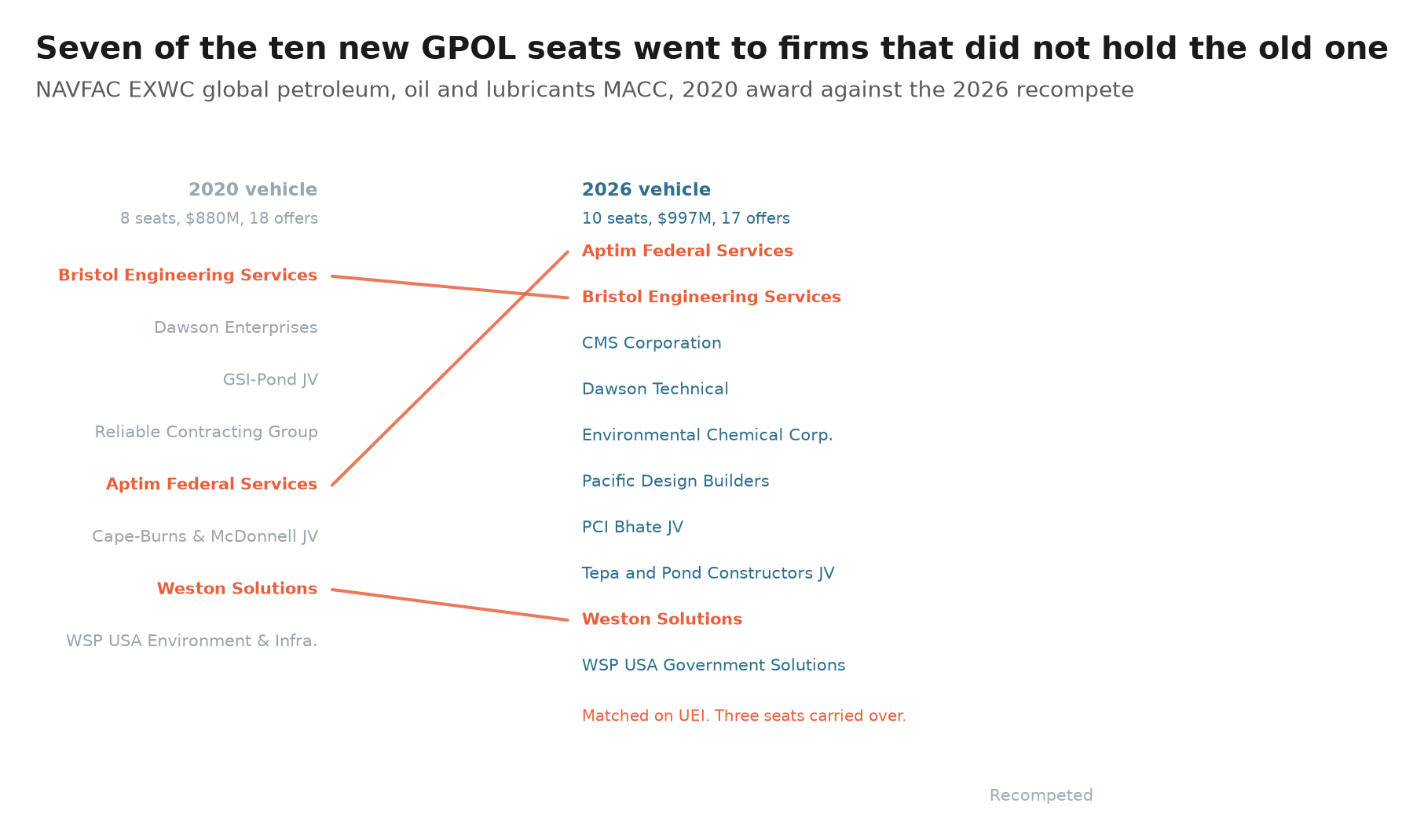
Seven seats went to UEIs with no position on the predecessor. Two of the eight 2020 holders come back under a familiar corporate name and a different legal entity, which the chart deliberately reads as new, because a capture team tracking the seat has to re-verify who actually signed.
The other five are off the vehicle.
The field held up too. The 2020 award drew 18 offers across eight seats, full and open, no set-aside, and the recompete drew 17 for ten.
Five and a half years of an incumbent group working a specialized worldwide scope left the bidder pool where it started.
The Ground Rules Did Real Work
Look at what the solicitation actually required, because this is the part a proposal shop can steal:
- Unrestricted with a small business reserve, sized at roughly half the awards, so a small business competed for a reserved seat rather than against the full field for all of them.
- A HUBZone price evaluation preference under FAR 19.1307 and FAR 52.219-4, applied on an unrestricted construction buy.
- Aggregate bonding capacity of $15,000,000 for small business offerors against $100,000,000 for large ones, a two-tier gate instead of one floor that quietly excludes everyone under a certain size.
- A priced seed task order as part of the proposal, bid-bonded at the lesser of $3,000,000 or 20% of that price, which forces a real technical solution rather than a capability narrative.
- A FAR Part 15 best-value tradeoff across technical approach, experience, past performance, technical solution, safety, small business utilization and price.
The seed task order came in at $587,438, and each awardee's guaranteed minimum is $10,000 for the life of the contract. Everything above that has to be won order by order, in a band running $500,000 to $25,000,000, against nine other primes who all cleared the same gates.
Final Thoughts
We were at this command five days ago on a different vehicle, reading a ceiling justification that cited unusual and compelling urgency after a regulatory change landed on a 2019 solicitation. Same building, different program, and the honest read is that a contracting shop is not one thing.
What the GPOL file shows is that the calendar is a choice. Twenty-two months of runway, an incumbent list published to the field, a reserve structure that gave small business a defined target, and enough schedule margin that a protest did not turn into a bridge. Seven new names on the vehicle is the output. The input was starting early enough that the answer could be someone other than the incumbent.
Thanks for reading.