 Recompeted
Research Is the Least Competitive Thing DoD Buys
We split every offer count in our expiring pipeline by product service code. R&D contracts drew a single bid 43.7% of the time, three times the construction rate, and the concentration sits in the fair-opportunity orders that ride multiple-award research vehicles.
The Defense Microelectronics Activity has two Raytheon orders in our expiration pipeline, four years apart, on the same parent vehicle.
$297.2M on HQ072721F1610, ending March 2027. $263.0M on HQ072725FE061, ending March 2028.
Both are coded full and open competition. Both drew exactly one offer.
We went looking for the anomaly there. That pairing turns out to be the pattern.
The Cut Nobody Runs
The desk refreshed its expiration pipeline this morning: 1,176 DoD prime contracts above $50M whose periods of performance end between Feb 5, 2027 and Jul 29, 2028, carrying $424.03B in obligations.
We pulled the FPDS offer count on every one of them. 823 report a count, 521 of those are coded competed, and 114 of the 521 drew a single bid.
Call it 21.9% overall, which is roughly where the desk's Aug 5 census landed on a slightly different window.
Then we cut it by product service code, which is the cut nobody runs, and the average stops meaning anything (chart below).
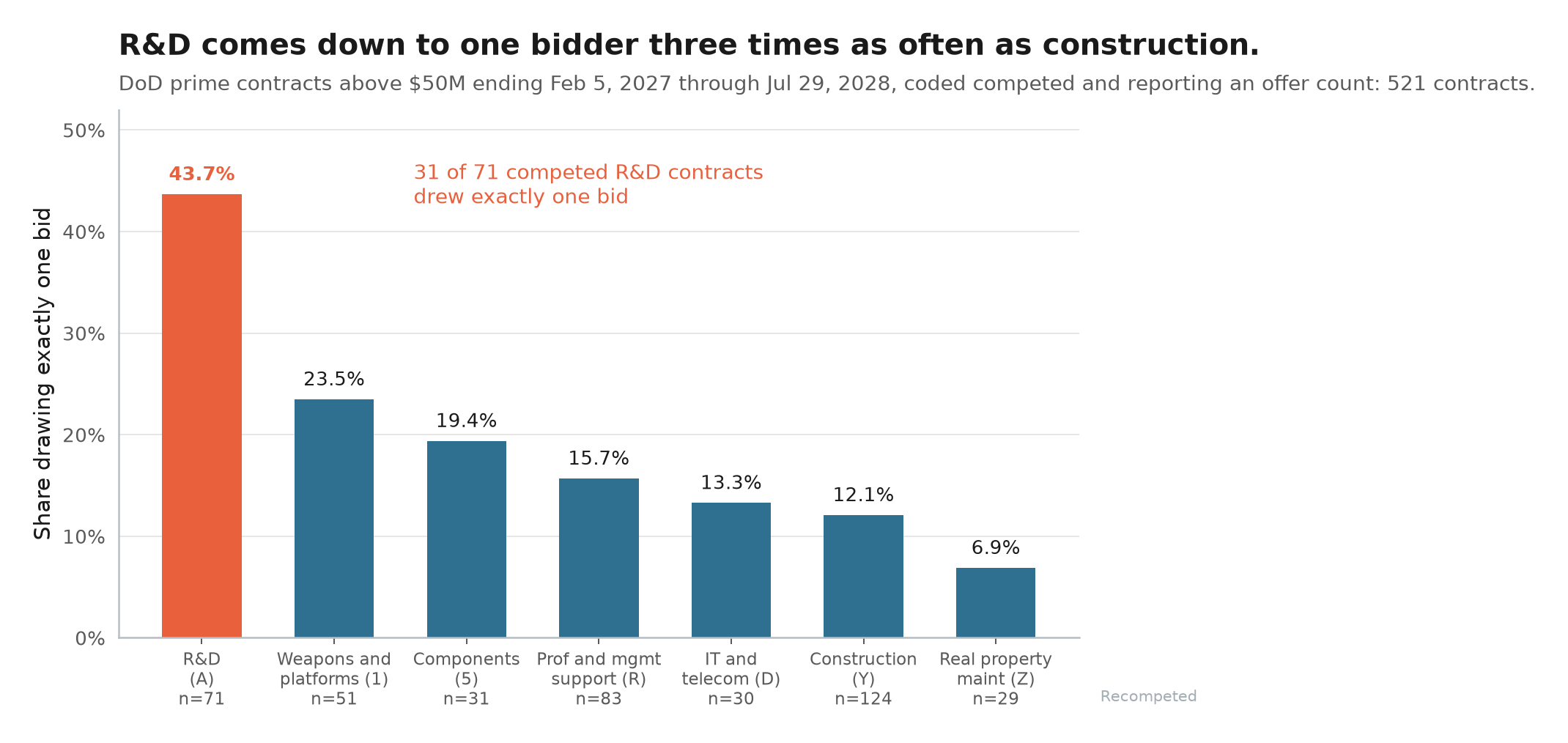
R&D sits at 43.7%: 31 of 71 competed contracts, one bidder.
Construction is at 12.1% on a larger base of 124. Professional and management support, the family most of this readership lives in, is 15.7%, and real property maintenance is 6.9%.
The median R&D contract in the window drew two offers. 47 of the 71 drew two or fewer.
So a services shop worried about single-bid awards is worried about the wrong family. Competition in R, D and Y is thin in places and perfectly healthy on average.
Competition in A has effectively stopped.
Where It Actually Happens
Split the same rows by contract structure and the mechanism shows up.
- R&D orders under a multiple-award IDIQ: 24 of 46 drew one bid, 52.2%
- R&D standalone contracts: 7 of 25, 28.0%
- Everything else, orders under a multiple-award IDIQ: 46 of 223, 20.6%
- Everything else, standalone: 37 of 227, 16.3%
Read the first and third lines together. On a research vehicle, the fair-opportunity call is a coin flip on whether anyone besides the intended awardee responds, and on every other kind of vehicle in the pipeline it draws a field four times out of five.
The Raytheon orders are both calls under HQ072716D0006, the Advanced Technology Support Program. Amentum's $173.8M emerging-capability prototyping order at Air Force office FA8075 (FA807522F0010) is a call under FA807518D0014.
Intrepid's $292.5M Army ERP order (W9126024F5009) is a small-business set-aside call that ran full and open after exclusion of sources and still drew one response.
Here's the catch: on a research vehicle the scope of a call is usually a continuation of work the recipient is already doing, defined in terms of the prototype it already built. The seat-holders who did not build it read the statement of work, price a losing bid, and pass. Which is a rational read of the incentives, and it means the ceiling number on an R&D IDIQ tells you almost nothing about how much of it is addressable.
What to Do With It
The competition on these programs happened once, at seat award, and the seat award is the only date worth chasing. Everything after it is an order to an incumbent with a running start.
For a capture team, that reorders the calendar. The addressable list sits one level up from those 71 contracts, at the vehicles behind them, and it carries different dates.
The honest limits on this cut, stated once: 823 of 1,176 rows report an offer count at all, because the field lives on the award action and does not always survive to the latest modification, so every rate here is computed on the reporting subset.
And this is one window rather than a trend. The desk has no prior PSC-family cut to compare it against, which is exactly why it now exists.
Final Thoughts
Single-bid awards get read as a procurement failure, and on a base operations recompete that read is usually right. On applied research it is closer to a description of how the work is bought: a technology gets a vehicle, a vehicle gets a builder, and the builder gets the follow-on because nobody else can price the thing they did not build.
None of that is going to show up in a protest. It shows up in a pipeline, one order at a time, at a rate the average hides.
Thanks for reading.