 Recompeted
Nothing Over $500 Million Is Set Aside
We pulled the FPDS set-aside determination on all 584 standalone DoD contracts above $50M that expire between February 2027 and August 2028. Set-asides carry 1.73% of the dollars, and above half a billion the share is exactly zero.
Seven of every ten dollars in the expiring DoD pipeline sit on contracts obligated at $500 million or more. Of the ones that carry their own set-aside determination, 100 contracts holding $257.89B, not a single one was awarded under a small business set-aside.
We refreshed the expiration pipeline this morning: 1,187 DoD prime contracts above the desk's $50M floor, end dates running 2027-02-12 to 2028-08-01, $427.19B obligated. Then we pulled the FPDS set-aside determination on every row. Delivery orders drop out of the count, because the set-aside decision on an order was made once, upstream, when the parent vehicle was awarded. What's left is 584 standalone contracts carrying $322.17B, each with its own answer to the rule-of-two question.
Fifty-nine of them are set aside. That is 10.1% of the contracts and 1.73% of the money.
The cliff is sharper than the average
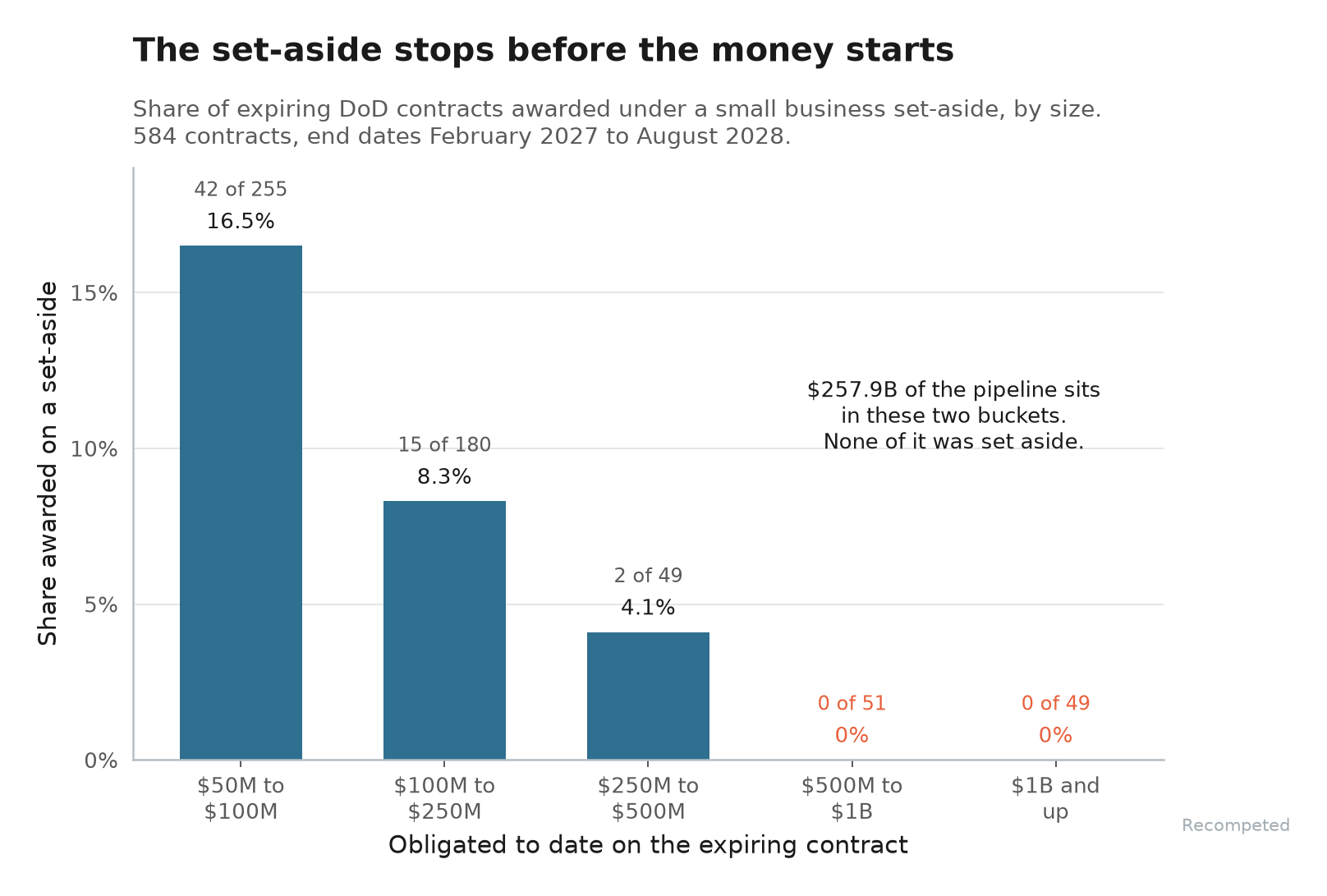
The 10.1% average hides the shape, and the shape is what you plan against (chart below).
In the $50M to $100M band, 42 of 255 expiring contracts are set aside. From $100M to $250M, 15 of 180. From $250M to $500M, two of 49.
Above that, across 100 contracts and $257.89B, the count is zero.
The largest set-aside in the whole forward pipeline is MDA's HQ085821C0014, held by MP Solutions for engineering and technical support, $327.6M obligated against a current end date of 2027-09-24 and a potential end of 2028-03-24. Two offers.
That contract is the ceiling, and it sits a full order of magnitude below the vehicles carrying the pipeline's real weight.
So the practical read for anyone under the size standard is that the set-aside path thins out past $250M and ends a little above $300M. Above that, the entry is a seat on somebody's team.
Services carry almost all of it
Set-asides cluster hard by what's being bought.
Services rows (alpha PSC, R&D excluded) run 44 of 263 = 16.7% set aside. Product and R&D rows run 15 of 321 = 4.7%.
Five NAICS carry half the fifty-nine: engineering services (541330, seven rows), heavy civil construction (237990, seven), R&D in engineering (541715, six), facilities support (561210, six), and commercial building construction (236220, four). By buyer, the Army holds 25, the Navy 12, the Air Force 11, and MDA 6 despite being a fraction of their size.
Two examples of the type, both Air Force base operations support on total small business set-asides: FA302923C0001 to ASRC Federal Gulf State Constructors, $208.2M, four offers, current end 2027-03-31; and FA300221C0003 to ASRC Federal Field Services at Vance AFB, $174.2M, four offers, ending 2028-03-31. Base ops, engineering support, heavy civil construction, environmental remediation, small-craft repair. The work that gets set aside is the work an agency can scope tightly enough to know a small business field exists.
The small side of the line is where competition happens
Here's the part that runs against reflex.
Among the 525 expiring contracts with no set-aside, 298 (56.8%) were never competed at all: sole source, only-one-source, or otherwise unavailable for competition. Among the 59 set-asides, that number is 10, or 16.9%.
Restrict both groups to what was actually competed and the set-asides draw a median of 3 offers against 2 for the open awards. The open population has a fatter tail (its mean is 8.3 offers, driven by the big multiple-award competitions), and it also has the sole-source bulk sitting behind it.
The set-aside band is small in dollars and dense in bidders. If you're pricing one of these recompetes, price it as a real competition.
Final Thoughts
Every one of these 59 determinations gets re-made at recompete. The agency redoes market research, re-runs the rule of two, and decides again whether two or more capable small businesses will bid at a fair market price.
Twenty of the 59 come off contract in February and March 2027, which means their market research is happening now, and a sources-sought notice is the visible edge of it.
That is the actionable half of a chart that otherwise just confirms what the industry assumes. The cliff is real and it is steep, and the place it moves is the band where it already exists, one requirement at a time.
Thanks for reading.