 Recompeted
Nobody Has a Real Two-Year Pipeline
Pull every DoD contract over $50 million that comes off in the next 24 months and the second year holds 612 awards against the first year's 1,537. The far end of a forward board is thin because most of the paper that will fill it has not been signed yet.
If you run a two-year pursuit board, the back half of it is thinner than the market it is supposed to describe.
We pulled every DoD prime contract over $50 million whose period of performance ends inside the next 24 months. Two passes, same endpoint, same floor, same agency filter, differing only in the window: the near board out to February 2027, and the desk's standing expiration pipeline from there to August 2028.
Deduplicated, that is 2,236 awards.
The next twelve months hold 1,537 of them. The eleven months after that hold 612 (chart below).
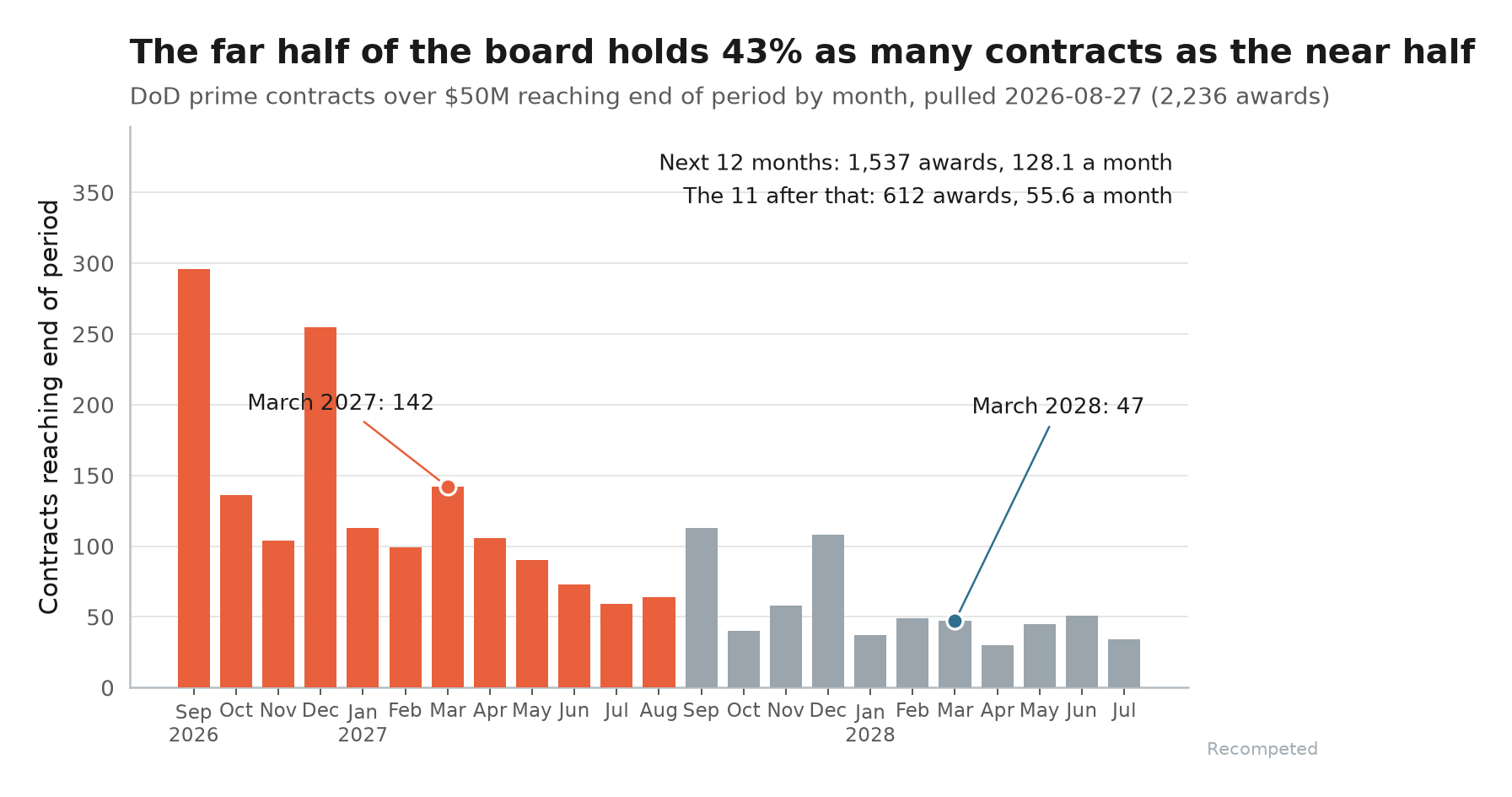
Call it 128.1 contracts a month coming off in the near year against 55.6 a month in the far one.
Same query, same dollar floor, same fiscal calendar underneath. The only variable is how far ahead you are looking.
Every month fattens as it gets closer
Hold the calendar constant and compare each month against itself a year later. The pattern lands eleven times out of eleven.
March 2027 has 142 contracts reaching end of period. March 2028 has 47.
October runs 136 against 40, April 106 against 30, January 113 against 37. The tightest pair on the board is June, at 73 against 51, and it still leans the same way.
So this is not a story about a quiet FY28. The September wall and the December cluster show up in both halves of the chart, just smaller in the half you cannot see clearly yet.
What has not been signed yet
A forward board can only carry paper that already exists in the public record, and three streams keep filling the far months in between now and then.
- Awards nobody has made. 205 of the 1,033 contracts on the near board, $26.9 billion of obligations, started inside the last 24 months. A board built two years ago could not have held them at any level of diligence.
- Options and extensions. Every exercised option and every bridge mod moves an end date outward, out of a month you already counted and into one you have not.
- Orders under vehicles that already exist. The IDIQ is on the record; the task order that will expire in FY28 has not been placed.
And the record trails the signature by a quarter. DFARS PGI 204.604(2), plainly: "CARs or their data are not available for public view or for non-DoD use until 90 days after the 'Date Signed' data element in order to minimize risk to military operations."
When this desk measured that lag against real movement last week, the median came in at 92 days.
A mod signed in June that pushes a contract from November 2027 into November 2028 is invisible to every commercial pipeline tool and every saved search until roughly September. Your FY29 column is being written right now in reports you are not allowed to read yet.
Where that leaves the plan
The near half is the half worth staffing against, and it is louder than most account plans treat it. 172 contracts worth $52.6 billion come off on a single date, September 30, which is 34 days out. Another 721 of the near board's rows are services work, $133.1 billion of it, which is the segment where a recompete actually changes hands rather than getting a sole-source follow-on.
The far half reads as shape. The 47 contracts sitting in March 2028 today are a floor on that month and never a forecast of it.
Anyone sizing an FY28 bid budget off a count that far out is sizing it off whatever fraction of the market happened to be visible on the day they pulled it.
The fix is cheap and nobody does it: re-pull the same window monthly and diff it, so you watch the far months thicken and learn your own tool's fill rate instead of trusting its face value.
Final Thoughts
Every BD organization we know builds the two-year board and then argues about which rows on it are real. The more useful argument is about the rows that are missing, because on this pull they outnumber the ones you can see.
None of this makes the far half worthless. It makes it a lower bound, and a lower bound is a fine thing to plan against once you stop reading it as a total.
Thanks for reading.