 Recompeted
How a Justification Gets Posted and Still Can't Be Read
We pulled all 262 DoD sole-source justifications posted to SAM.gov in October and tried to extract text from every one. Only 114 gave any up. The other 148 split four ways, and one of those ways is a notice that carries no document at all, just a link into a second portal.
"Point a scraper at every DoD sole-source justification posted last month. How many can it actually read?"
We ran it.
262 notices of type Justification went up on SAM.gov between October 1 and October 31 under a Department of Defense component.
We fetched every one's attachment payload, downloaded every file on it, and pushed each PDF through a text extractor.
114 gave text back.
That is 43.5% of the month's sole-source record (chart below). Every competitive-intelligence product you have ever been quoted a five-figure price for is built on indexing that record, and in October the index could reach fewer than half of it.
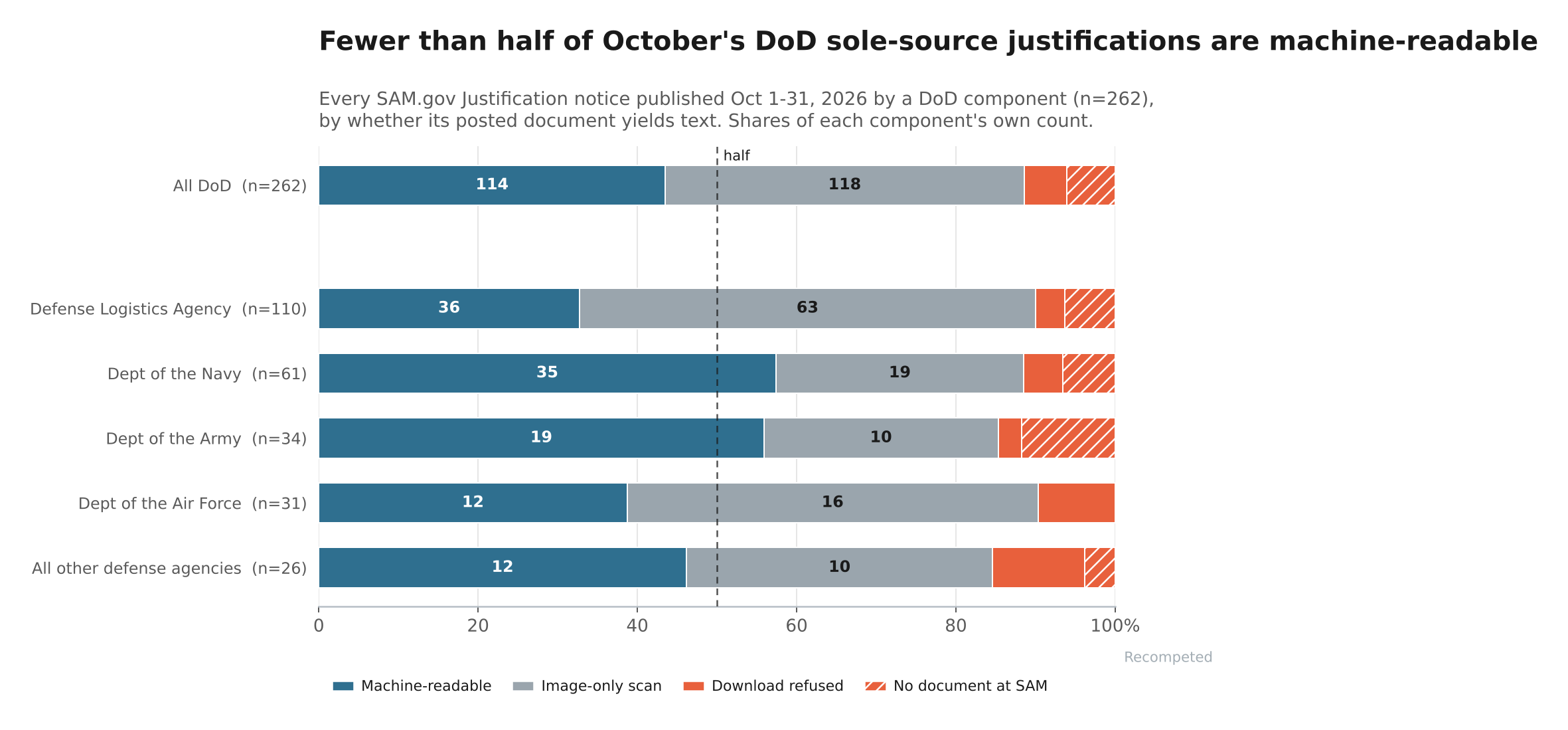
Where the other 148 went
The shortfall is four separate problems wearing one coat:
- 118 image-only scans. The PDF downloads fine and contains no text layer. Somebody printed the signed justification, ran it through a scanner, and posted the picture.
- 14 refused downloads. The file is attached and listed, and the download endpoint answers HTTP 401,
"User is not authorized to download the attachment."The attachment carriesaccessLevel: private. DISA's Pegasus Support Bridge is one. So are the Air Force's AMRAAM Production Lot(s) 41-47 and Fifth Generation Datalinks Support. - 15 with no document on SAM at all. The notice posts zero files. Ten of the fifteen carry a link into PIEE, the department's own solicitation module, and the rest of the attachment list is PIEE training material and a pointer to the DoD Procurement Toolbox.
- 1 that posts no file and no link.
We reported the 14 on October 29, when the month was still open and the count was the same. The scan number is new.
The desk measured it on a 48-hour sample on the 31st and got 9 of 20 readable, which turned out to be a good guess at a month that came in at 114 of 262.
The threshold is not doing any work here
Where you put the line between "has text" and "does not" usually decides an answer like this. Not this time.
Of the 232 notices carrying a downloadable PDF, 115 return exactly zero characters. Not a header, not a page number, nothing.
116 return 50 or fewer, 114 return more than 400, and precisely 2 land anywhere in between.
The population sorts itself into two piles and leaves two documents on the floor.
The PIEE tier is the interesting one
FAR 6.305(d)(1) says the justification shall be made publicly available "at the Government Point of Entry (GPE) https://www.sam.gov." Paragraph (d)(2) adds the agency's own website, "which may provide access to the justifications by linking to the GPE."
The direction of that link matters, and for fifteen notices last month it ran backwards.
We loaded one in a real browser to check the document is genuinely there. It is: notice W912L126QA016, an Army oxygen-bottle justification, renders an attachment table in PIEE holding Sole_Source_Justification_Redacted_01Oct2026.pdf, dated October 1.
Fetch the same URL with anything that is not a browser and you get 27,696 bytes of JavaScript shell with no mention of the file in it.
So the paper exists, a person can reach it, and the GPE is holding a pointer where the regulation describes a document.
What DLA does to the number
Pull the department apart and the average stops being one problem.
DLA posted 110 justifications in October, more than Navy and Army combined, and 36 of them are readable. That is 32.7%, against the Navy's 57.4% and the Army's 55.9%. The Air Force sits at 38.7% on 31 notices.
Weight that by who files most and you get the month's headline on your screen.
If you track parts and sustainment, your blind spot is roughly two thirds of the filings. If you track Navy services, it is closer to four in ten.
Final Thoughts
None of this is a compliance finding, and we would not pitch it as one.
FAR 6.305(e) tells contracting officers to screen and redact before posting, (f) carves out what would disclose the agency's needs, and twelve of the fourteen locked files have _Redacted sitting right there in the filename. People did the work the rule asks for.
The rule just never said the posted thing had to be readable by a machine, because in 2010 nobody was reading it with one.
What that leaves you is a sourcing problem with a known shape.
More than half of the sole-source record arrives as a picture, a locked file, or an address, and the tools that promise you full coverage of it are indexing the same 43.5% you are. The gap sits deepest exactly where the volume is, and it is cheap to measure again next month.
Thanks for reading.