Every End Date You Track Is 92 Days Stale
We diffed fifteen sweeps of our own expiration board and caught 33 DoD contracts moving their end date. Not one of them moved it this month. Every change traced back to a modification signed in April or May, surfacing on the day DoD's public-release delay ran out.
Thirty-three contracts on our expiration board changed their end date over the last two weeks.
None of them changed it in the last two weeks.
We keep the board in a checked-in CSV and commit it with every post, so git holds a snapshot of the whole $50M-plus DoD forward book on every sweep. Fifteen live sweeps ran between August 3 and August 18.
Diffing them is the cheapest experiment available to us, and we had never run it.
"If we watch the same 1,229 contracts every day for two weeks, how many of them move?"
33, or 2.7% of the contracts observed in at least two sweeps.
The direction is the surprise: 31 moved later, 2 moved earlier. Zero moved and came back.
The Window Edge Doesn't Explain It
The obvious objection is that our own screen manufactures the asymmetry. The board is a 6-to-24-month forward window whose near edge advances daily, so a contract sliding earlier could drop off the front uncounted.
So we re-ran it on the subset that cannot: rows ending 2027-05-01 or later, at least 75 days clear of the final edge. That leaves 879 contracts, 19 movers, a 17 to 2 split.
Same shape. The rightward drift is real, and carries $5.7B in obligated dollars.
Ninety Days, Plus Two
Here's the part that reframes the exercise. We pulled the FPDS record for every mover, found the modification reporting the new completion date, and differenced its signature date against the sweep that first showed it.
The lag is not noisy. It is a spike (chart below).
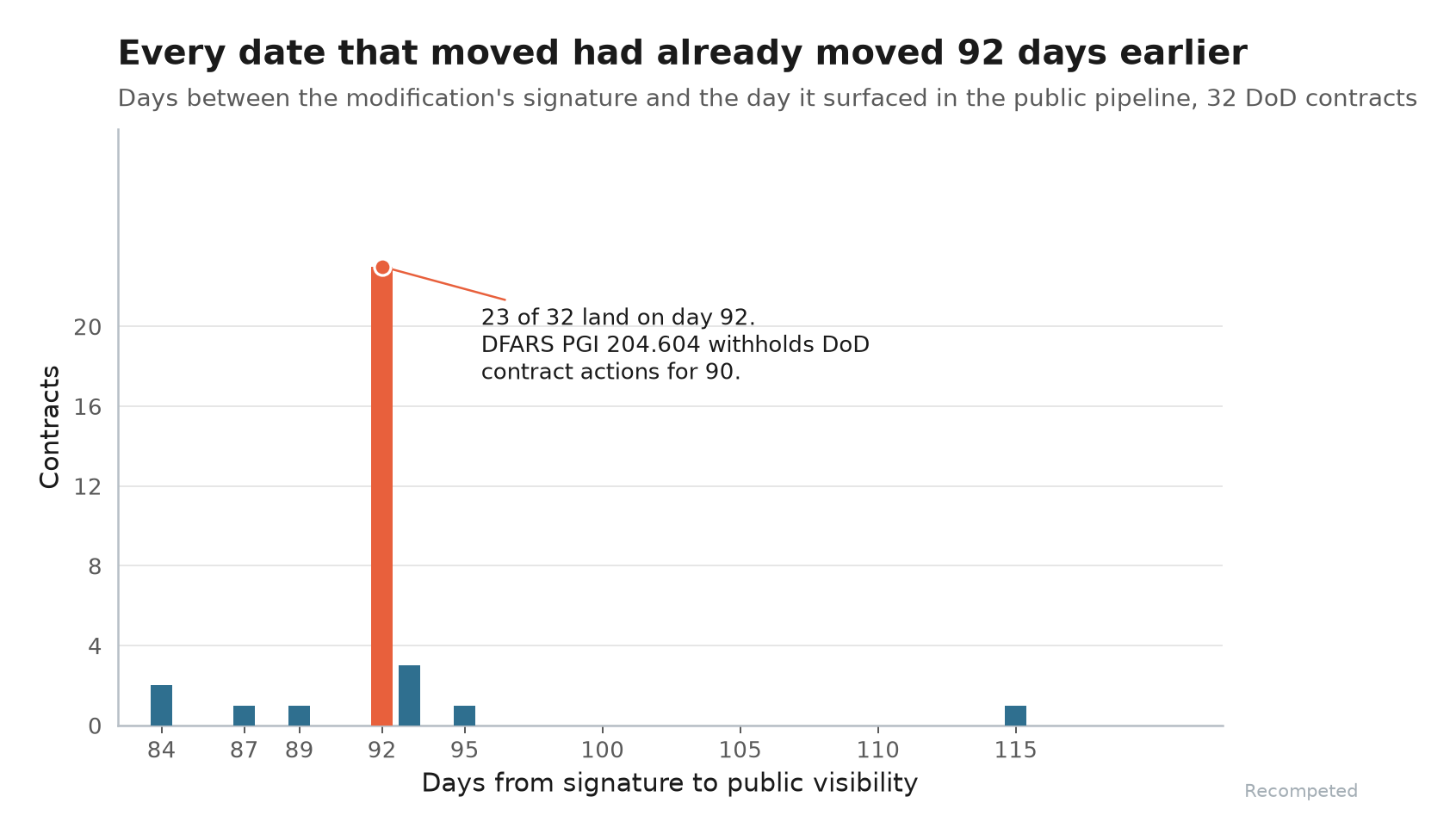
23 of the 32 resolvable movers land on exactly 92 days. The median is 92, the whole range runs 84 to 115, and every driving modification was signed between April 13 and May 18.
DFARS PGI 204.604 is doing this, and it says so plainly: contract action reports "are not available for public view or for non-DoD use until 90 days after the 'Date Signed' data element in order to minimize risk to military operations." Add a couple of days for the load cadence between FPDS release and the snapshot we read, and you get 92.
So the board didn't update in August. August is just when DoD stopped withholding what it signed in the spring.

The rest of this brief is for subscribers.
The specific solicitations, dockets, and dates to act on sit past this line.
$50 a month, or $500 a year.
Already a subscriber? Sign in