 Recompeted
$71 Billion Comes Off Contract With a Partner's Name on It
156 of the 1,208 DoD contracts running out between March 2027 and September 2028 carry foreign funding on their latest recorded action. 85.3% of them are coded not competed, against 40.2% for everything else, and the gap holds in every family on the board.
"Which rows on the expiring board were never going to be competitions?"
Friday's Pentagon board answered part of that in a single paragraph. American Systems Corp. took a $30,579,869 modification for a P-8A maintenance trainer update, work split evenly between Jacksonville and Edinburgh, South Australia. Of the money obligated at award, $14,112,206 is Royal Australian Air Force funds. The entry closes with a line none of the other modifications on Friday's board carry: this contract was not competed.
The underlying contract, N6134022C0001, sits on our expiring board with $109,071,594 obligated and a period of performance that runs out Dec. 31, 2027.
So we pulled the foreign-funding code on every row of that board.
What the Flag Is Worth
FPDS records it on every action: foreign funds FMS, foreign funds non-FMS, or not applicable.
Of the 1,208 DoD contracts ending between March 2027 and September 2028, 156 carry one of the two foreign codes on their latest recorded action. That is 12.9% of the rows and $71,485,797,030 of the board's $437.6B in obligations, so 16.3% of the money.
139 of the 156 are FMS.
Those 156 are coded not competed 85.3% of the time. Everything else on the board: 40.2%.
The obvious objection is mix. FMS money lands on fighters and missiles, and fighters and missiles are noncompetitive anyway.
So we split the board into families and ran it again (chart below).
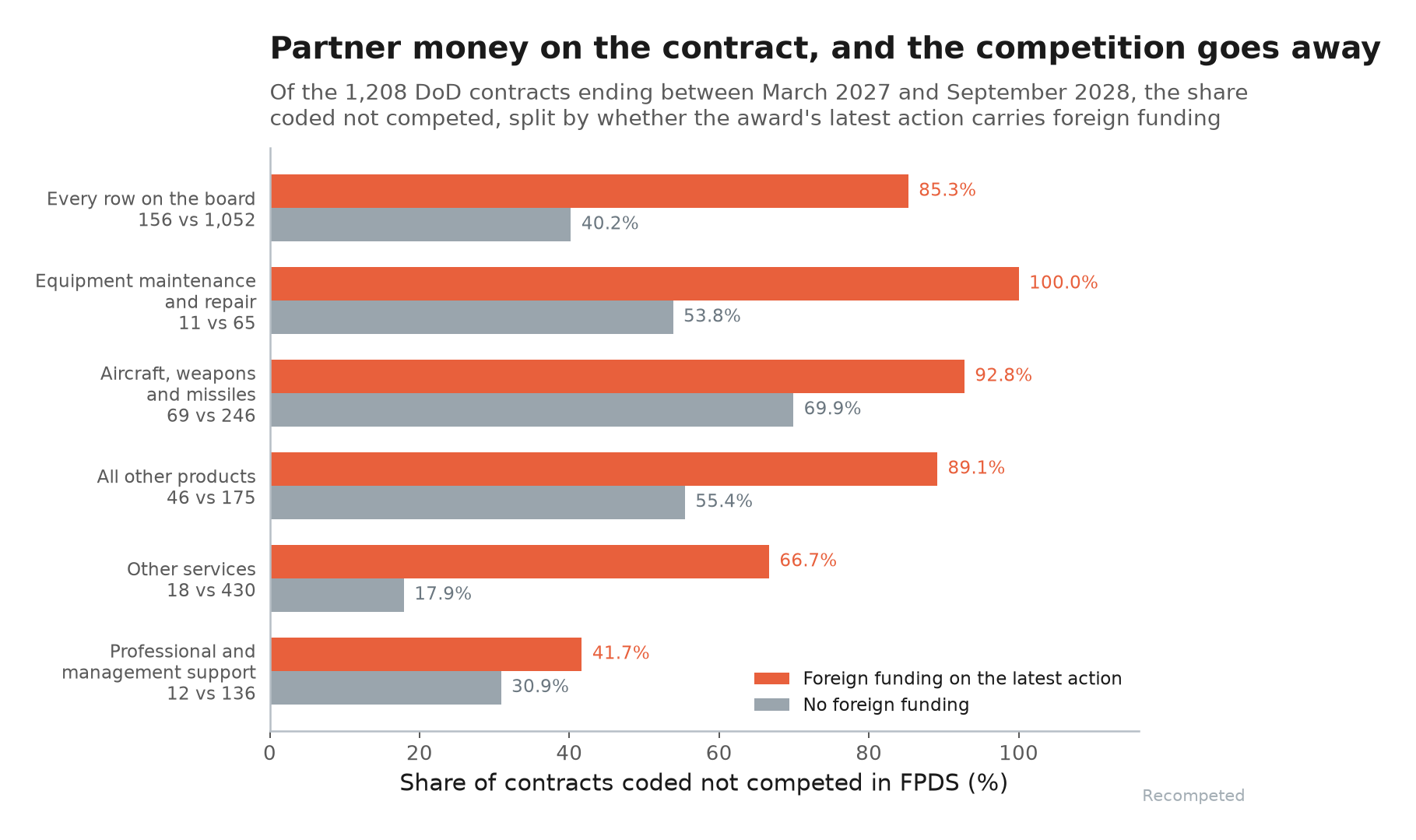
The gap survives in all five families. Aircraft, weapons and missiles go from 69.9% noncompetitive to 92.8% when partner money is on the contract. Equipment maintenance and repair goes from 53.8% to 100%, on eleven rows. Even professional and management support, where a noncompetitive award is the exception, moves from 30.9% to 41.7%. Among the rows that report an offer count, 88 of 107 foreign-funded contracts drew exactly one, against 356 of 753 for everyone else.
Two Reasons, and One of Them Is Load-Bearing
The exception authority tells you which kind of closed door you are looking at.
- FAR 6.302-1, only one source: 86 of the 156. The familiar one. It rests on a technical data, tooling or continuity argument, and arguments get re-litigated at the next acquisition strategy review.
- FAR 6.302-4, international agreement: 30 of the 156, carrying $13,612,316,186. Thirty of the thirty-eight rows on the entire board citing 6.302-4 are foreign-funded.
That second authority is the one worth reading closely. When the partner's letter of offer and acceptance names the source, the contracting officer is executing an agreement between two governments, and there is no competitive strategy sitting behind it waiting for a better year. Raytheon's THAAD radar sustainment (HQ086220C0001, $549,169,489, ends Feb. 28, 2028), General Atomics on the Spain CLS follow-on (FA868922C2019, $53,156,142, ends Jul. 31, 2027) and Raytheon on the Qatar air operations center upgrade (FA238325CB008, $50,808,347, ends Apr. 30, 2027) are all coded that way, all at one offer.
What It Looks Like in Services
Twelve of the 156 sit in professional and management support, and they split on one thing: whether the requirement itself names a partner.
The five whose descriptions do (AUKUS program office support, CH-47F engineering for Germany, the Lithuania AN/TPS-77 radar program, Spain contractor logistics, the Qatar air operations center) are all coded not competed. The other seven, generic program management and A&AS scopes, are all coded competed: five full and open, two full and open after exclusion of sources. Systems Planning and Analysis holds the AUKUS line at $159,615,901 through Mar. 31, 2028, one offer, 6.302-4.
Final Thoughts
The flag is conservative, because FPDS applies it action by action. American Systems' own row is still coded not applicable today, on a record last touched in June, while Friday's board says Australian money is going onto the contract this month. Which means the true partner exposure on the board is somewhat higher than 156 rows and $71.5B, and you find it in the announcements before the data catches up.
Worth doing before the capture spend, then: read the foreign-funding code and the exception authority on the incumbent's latest action, alongside the end date you are already forecasting against.
A 6.302-1 justification is an argument somebody can lose. A 6.302-4 is a document two governments already signed.
Thanks for reading.