 Recompeted
$226 Billion Shows Up on the Board After the Fact
651 of the 6,482 award paragraphs on the last 500 Pentagon daily boards carry a stamp saying the contract was already signed, $226.2 billion of them. A quarter print more than ten days after the award, and in the DLA section it is more than half.
The Defense Health Agency put $100,000,000 on Wednesday's board, a firm-fixed-price contract to BCG Federal Corp. of Bethesda, Maryland, for Workforce 3.0 support at its healthcare management systems program office.
The last thing the entry says is "(Awarded July 30, 2026)."
That contract had been in force for 41 days before the Pentagon told anyone it existed, and its period of performance started August 1.
As of this morning, HT003826FE012 still returns nothing on USAspending.
"How much of the daily board is already history by the time it prints?"
The Stamp Is the Whole Signal
DFARS 205.303 puts the reporting threshold for DoD awards at $9 million of face value, and tells the buying activity to submit the announcement to public affairs "by the close of business the day before the date of the proposed award." Next day is the design.
So we pulled every daily contract announcement article the war.gov feed carries and counted the departures from it. The corpus is 500 boards, July 22 2024 through September 9 2026, 6,482 award paragraphs:
- 651 of them, 10.0%, carry an explicit "(Awarded date)" stamp.
- They sit on 277 of the 500 boards and total $226.2 billion of announced face value.
Most of that backdating is harmless. The median stamped entry runs 4 days behind its award, which is a Friday signature printed on Tuesday, and Wednesday's board carried two more in that range.
Here's the catch. The tail is heavy: 25.2% of stamped entries print more than ten days after the award, and 13.4% more than thirty.
Where the Feed Goes Stale
The lag concentrates, and the chart below has the shape of it.
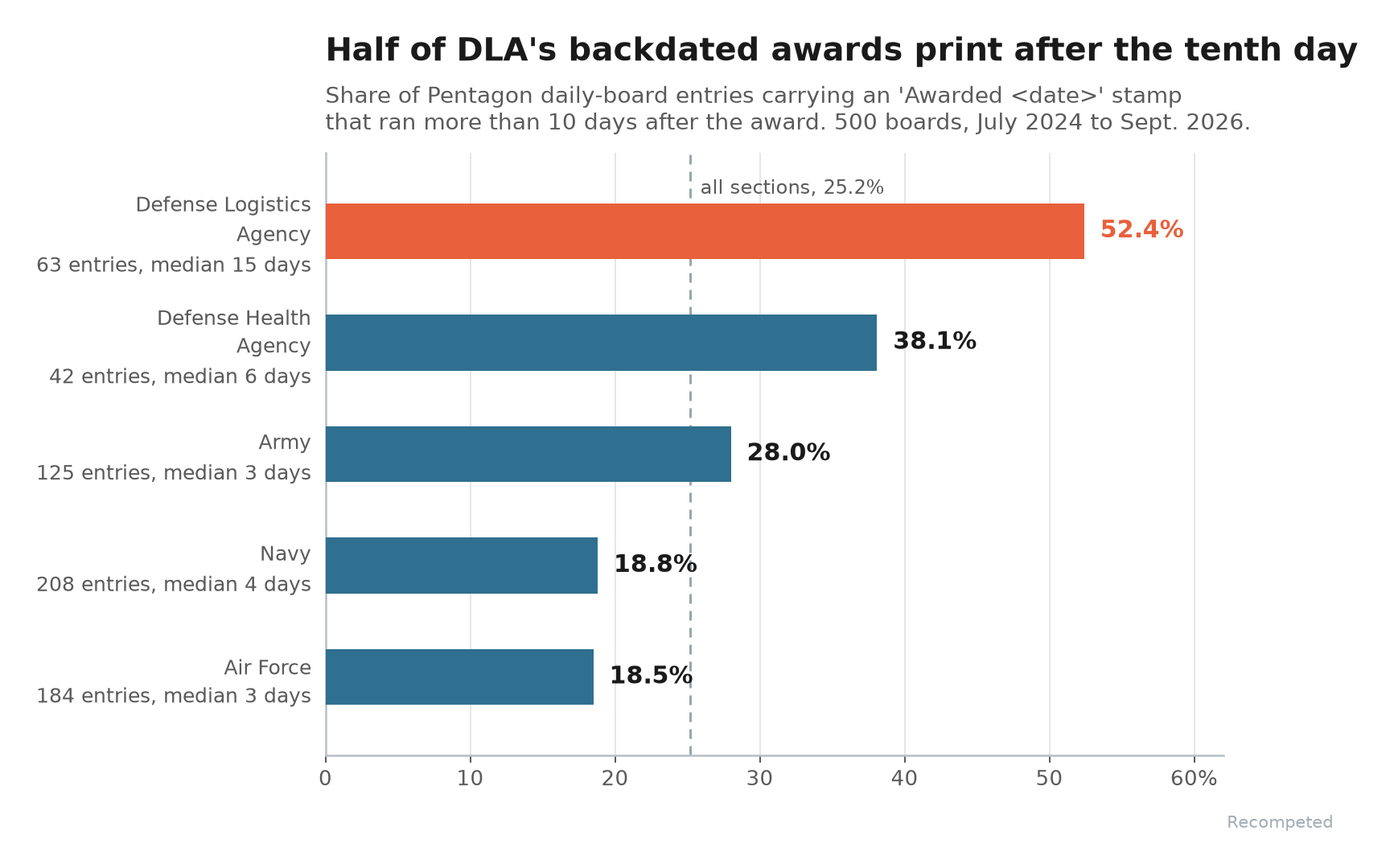
DLA runs its own regime. 52.4% of its backdated entries clear ten days against 18.5% at the Air Force, and its median stamp is 15 days against three.
The record holder is a $51,542,494 GE delivery order for TF34 engine supplies that appeared on the May 6 2026 board reading "(Awarded on Dec. 19, 2023)", a gap of 869 days.
DHA sits second at 38.1%, which puts BCG Federal inside the pattern. Four other Defense Health entries in the corpus ran longer than 41 days, topping out at 105.
And the stamp is spreading. 6.4% of 2024's award paragraphs carried one. 12.5% of 2026's do.
What That Does to Your Week
Under 4 CFR 21.2(a)(2) a protest is filed "not later than 10 days after the basis of protest is known or should have been known," with a carve-out that moves the clock to the debriefing where one is required. If you competed, FAR 15.503 notice reached you well before public affairs got involved, and the board was never your clock.
The board matters for the ones you never got to bid on:
- A sole source you would have challenged, stamped forty days back, has been in performance for six weeks by the time you read the line.
- An incumbent's scope moving onto somebody else's vehicle surfaces the same way, with the transition already underway.
- Anything in the DLA section arrives, one time in two, on the far side of the ten-day mark.
The board is an excellent record of what happened. It is a poor trigger, and the two sections where a quiet services move is most likely to surface are the two slowest to print.
Final Thoughts
None of this is concealment. The stamp is the agency volunteering the real date, and the 5,831 paragraphs carrying no stamp at all are the ones you have no way to age.
What the census gives you is the floor under your own monitoring. If a pipeline tool ingests the daily board and your team treats the output as an alert, you have accepted a lag nobody priced, and at DLA and DHA that lag is the difference between watching a recompete and reading about one.
Thanks for reading.